
What Concrete Cylinder Break Tests Reveal About New Home Slabs
Explore Our Services
Contact Us Today!
(239) 322-9295
Concrete cylinder break tests give builders a measured result for the strength of a concrete sample. They can help show whether concrete is developing as expected, but they don't directly test every part of your new home's slab.
That distinction matters when you're reviewing construction records. A test report is one piece of information, alongside the approved plans, placement records and inspections. Here's what the results can tell you, and where their limits begin.
Key Takeaways
- A cylinder break test measures the compressive strength of a concrete sample, usually reported in units such as pounds per square inch.
- Results taken at different points in the concrete's strength development need to be interpreted in context and compared with the project's specified requirements.
- A test cylinder is a sample, not a section of the finished slab. Its result can't prove that every area of the slab has the same strength or condition.
- If a report raises concern, ask the builder to explain it in relation to the project documents. A qualified engineer can assess structural questions.
What Concrete Cylinder Break Tests Measure
Concrete cylinder break tests measure how much compressive force a concrete specimen can withstand before it fails. A testing machine applies pressure to the cylinder, and the resulting measurement is used to calculate its compressive strength.
The report gives a result for the specimen tested. That result can then be compared with the strength specified for the project's concrete mix. The specification and the test result answer different questions: one states the required performance, while the other records the sample's measured performance.
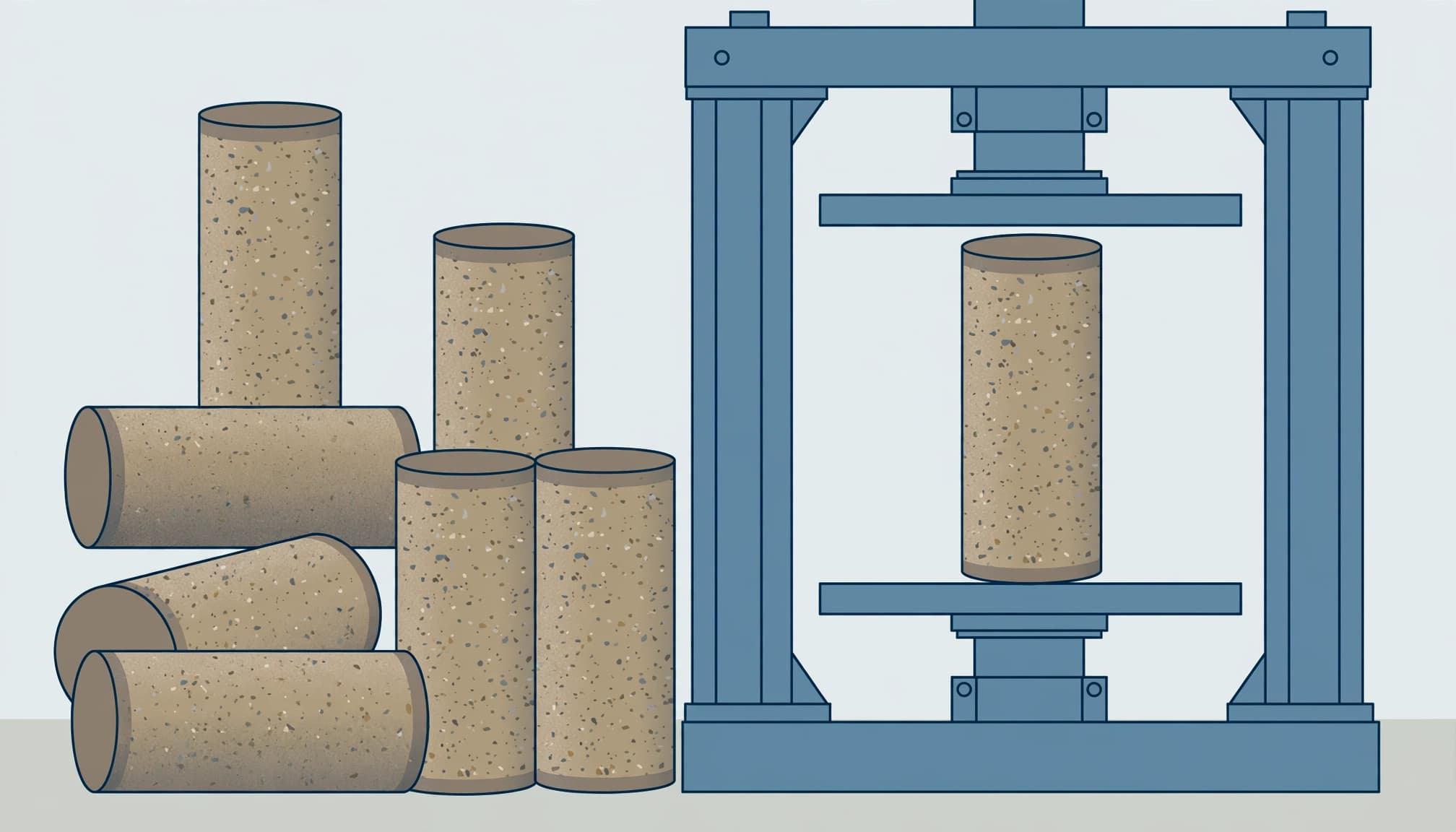
The result is about compression
Concrete performs well under compressive loads, which push material together. A cylinder test focuses on that property. It doesn't directly measure every characteristic of concrete, such as how a slab handles bending, how it resists cracking, or how water moves through it.
That's why a strength result shouldn't be treated as a complete quality rating. It gives useful information about one measurable aspect of a concrete sample.
The project specification gives the result meaning
A number on a report needs a reference point. The builder, design professional or engineer can compare it with the strength requirement and relevant project records.
A result can't be judged fairly in isolation. The concrete mix, test timing and handling of the specimens all help frame what the reported measurement means.
How Test Results Are Interpreted Over Time
Concrete gains compressive strength as it hardens. For that reason, results from specimens tested at different points in this process can differ. A lower early reading alone doesn't tell you whether the concrete will meet the project's requirement at the point that matters.
The interpretation depends on the project specification and the test schedule. The report should identify when a specimen was tested, while the construction team can explain how that measurement fits the specified strength requirement.
Compare results at the right point
Results should be considered in relation to the stage of concrete strength development they represent. Comparing a result from an earlier point with a requirement intended for a later point can lead to the wrong conclusion.
Likewise, test results from different jobs may not be directly comparable. Mixes, project specifications and conditions vary. The useful comparison is the one tied to your home's approved documents.
Look at the pattern, not one number alone
A series of test results can give a clearer picture than a single result. The project team can consider whether the readings follow the expected pattern and whether they meet the applicable requirements.
If a result is lower than expected, it calls for context rather than an automatic conclusion about the slab. The builder and, when appropriate, the engineer can review the report alongside the concrete placement and project records.
A Test Cylinder Is Not the Finished Slab
Test cylinders are samples of the concrete, not direct tests of the finished slab. They're prepared from concrete associated with the placement and tested separately. Their purpose is to provide information about the sampled concrete under the conditions represented by the specimens.

A sample represents only what it can represent
A cylinder result can provide evidence about the concrete sampled, but it can't confirm that every part of a broad slab is identical. Conditions during placement, finishing and subsequent exposure may vary across the pour.
That's why a report should be read as one part of the quality record, not as a map of the entire floor. It doesn't identify the condition of a particular corner, edge or area of the slab.
A slab has more to it than concrete strength
The performance of a home's foundation also depends on the design and construction of the slab system. Preparation of the base, reinforcement, slab thickness, moisture protection, drainage and site conditions all matter.
A cylinder report doesn't confirm that those elements were installed as planned. They're addressed through project documents, construction oversight and inspections that take place at different stages.
What a Result Can Tell You About the Concrete
A result that meets the project requirement supports the conclusion that the tested specimen achieved the specified compressive strength under the conditions represented in the report. That's useful evidence for the construction team as work advances.
It isn't a blanket statement that every part of the slab is flawless. Nor does it replace the design professional's judgment about whether the next construction activity is appropriate.
When results meet the requirement
If the results align with the project specification, they provide reassurance about the strength performance of the sampled concrete. The builder can interpret them alongside the schedule, placement records and inspection status.
A favorable result is still limited to the test and specimen it describes. It doesn't assess cracks, surface finish, slab moisture or whether foundation details match the approved drawings.
When a result raises questions
A result below an expected requirement deserves review, but it doesn't automatically prove the home's slab has failed. The meaning depends on the applicable specification, the test timing and the broader project record.
The builder should explain the result and the next step. If the issue involves structural performance, a qualified engineer should review the available information and determine whether further evaluation is needed.
What Cylinder Tests Cannot Tell You About the Finished Slab
A cylinder test doesn't inspect the slab in place. It can't show whether the base was prepared properly, whether reinforcement sat in the planned location, or whether the slab was placed and finished in line with the approved plans.
It also doesn't diagnose every crack or movement concern. Those issues need to be assessed based on their location, appearance, change over time and relationship to the structure.
Strength and moisture are different questions
A compressive strength result doesn't tell you whether a slab is ready for flooring. Moisture testing addresses a different concern, and flooring products have their own installation requirements.
Similarly, a cylinder report doesn't establish that the slab is dry because the surface looks dry. A strength measurement and a flooring moisture evaluation answer separate questions.
A report doesn't replace inspections
Pre-pour inspections allow required work to be reviewed before concrete covers it. For a slab, that may include items such as the base, vapor barrier, reinforcement and forms, depending on the permit and local process.
In Fort Myers, pre-pour footing inspections address foundation work before concrete placement. A slab vapor barrier checklist covers visible preparation items. Neither is the same as a cylinder test, and a test report doesn't replace an applicable inspection.
What to Do If You Have Concerns About a Result
Start with the builder, who can explain which concrete placement the report covers and how the reading compares with the project requirement. Ask for the result to be reviewed alongside the relevant construction records, not as a standalone number.
If the answer points to a possible structural concern, the builder should involve a qualified engineer. An engineer can assess the project-specific documents and determine whether the information supports further investigation or another response.
Keep the report with your home's construction records. It may be useful later alongside approved plans, inspection records and concrete placement information.
Frequently Asked Questions
Does a passing cylinder test prove the whole slab is sound?
No. It shows how a particular concrete sample performed in compression. It doesn't directly test every part of the slab or confirm the quality of each construction detail.
Can one low result prove there's a foundation problem?
No. A low result needs to be interpreted against the project specification, test timing and other records. The builder should review it, and a qualified engineer should assess structural concerns.
Are cylinder tests the same as a slab inspection?
No. Cylinder tests measure the strength of concrete samples. Inspections review construction work at specific stages, including visible details before a pour. Both can be part of the project record, but they serve different purposes.
Understand the Report in Context
A cylinder break test is a useful measure of concrete's compressive strength, but it doesn't describe every condition of a new home slab. The sample and the finished foundation are related, but they aren't interchangeable .
If a result concerns you, have the builder explain it in relation to the project requirements and records. Bring in a qualified engineer when the question involves structural performance.