Can You Build a Pool Under Power Lines in Fort Myers?
Explore Our Services
Contact Us Today!
(239) 322-9295
Sometimes, but a gunite pool beneath overhead power lines is feasible only when electrical clearances, utility requirements, and local permitting allow it. A pool under power lines can also be ruled out by the type of service crossing the yard.
The finished pool location and construction work need separate safety reviews. Before design or construction, have your contractor establish the applicable requirements with the serving utility and the City of Fort Myers or Lee County permitting authority.
Key Takeaways
- Overhead distribution lines, service drops, and utility poles can have different placement restrictions.
- A compliant finished pool doesn't automatically provide safe working space for construction equipment.
- Your parcel's jurisdiction determines whether City of Fort Myers or Lee County permitting procedures apply.
What Determines Whether a Pool Under Power Lines Is Allowed?
Gunite construction doesn't create an exemption from electrical-clearance requirements. The line type, voltage, conductor arrangement, and pool layout all affect feasibility.
FPL's preferred separation isn't a universal rule
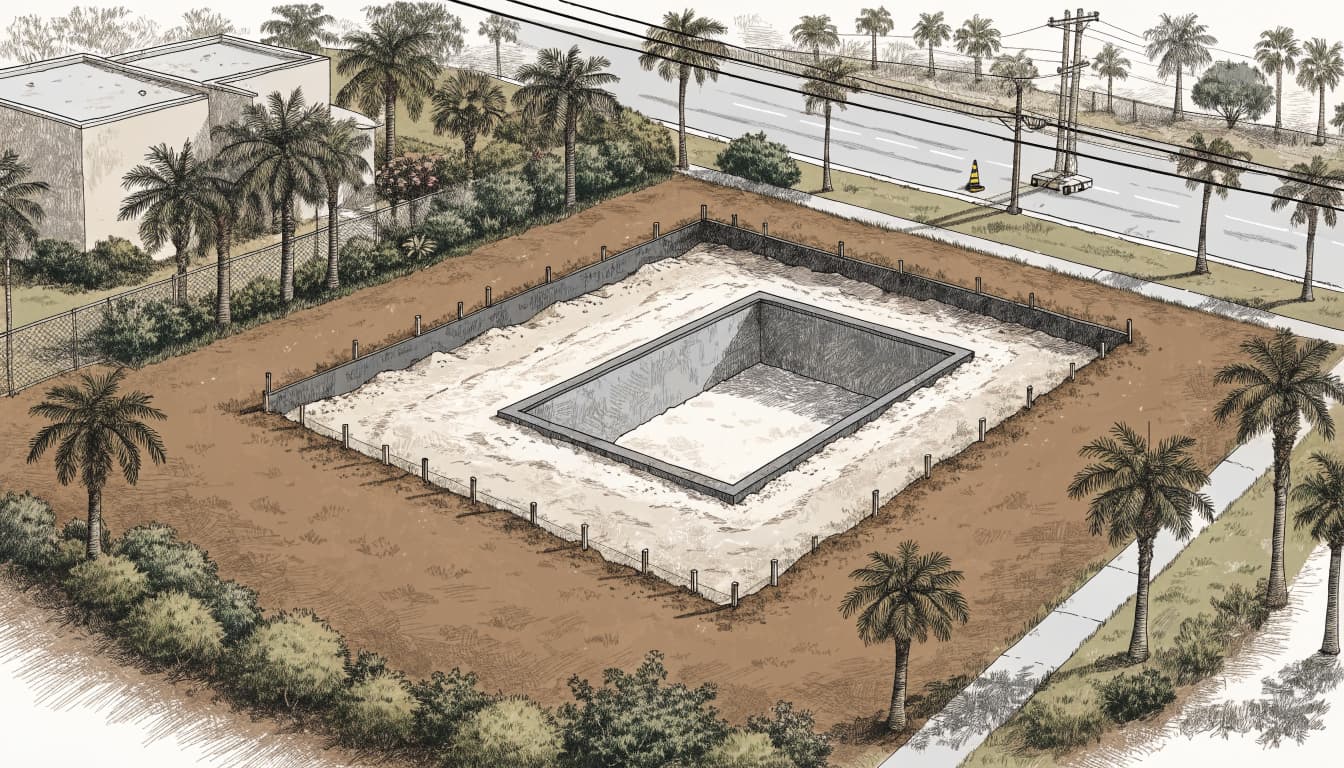
Florida Power & Light's Electric Service Standards state a preference for 10 feet of horizontal clearance between its facilities and pool edges or enclosures.
However, FPL also allows consideration of smaller horizontal separations when specified conditions, including minimum vertical clearances under the National Electrical Safety Code, are satisfied. That preference isn't a blanket approval for every line above every pool.
Clearance review must account for conductor sag and the proposed pool and enclosure elevations. A homeowner's measurement from the ground doesn't establish compliance.
Service drops have different restrictions
FPL says an overhead service entrance should be arranged so service-drop wires don't cross a swimming pool. It also states that a service pole must not be within 25 feet of a pool .
These restrictions are different from the preferred horizontal separation. Therefore, identifying whether the wire serves your house or belongs to another overhead circuit is an early design decision.
An unacceptable crossing may require a different pool location or utility-approved service changes.
Construction Hazards Need Their Own Safety Plan
Even when the completed pool can meet applicable requirements, excavation and installation may create hazards that the finished layout doesn't show.
Raised equipment can enter overhead clearance zones
Excavator booms, raised dump beds, lifting equipment, and long reinforcing steel can reach higher than expected. Equipment movement also changes as crews load soil or reposition around the excavation.
The contractor needs an equipment-specific plan based on the utility's line information and applicable worker-safety requirements. Neither a pool setback nor FPL's preferred horizontal separation establishes an equipment approach distance.
Approval of the finished pool location doesn't establish safe operating clearance for construction equipment.
If the proposed work can't maintain required separation, the construction approach must change before equipment enters the area. Any relocation or de-energization must be coordinated with the utility.
Underground utilities create a separate excavation risk
Overhead wires don't reveal every utility serving the property. FPL directs excavators to contact 811 at least two full business days before digging , excluding weekends from that notice period.
Public utility markings also don't identify every privately installed line. Irrigation wiring, private electrical feeds, propane piping, and other homeowner-installed services may need separate locating.
The excavation plan should address both marked utilities and private services. Digging near utility facilities requires appropriate exposure methods and added caution.
Fort Myers and Lee County Have Different Permit Paths
A Fort Myers mailing address doesn't establish permitting jurisdiction. Properties inside city limits follow the City of Fort Myers process, while unincorporated properties follow Lee County procedures.
The city publishes a pool, spa, and fountain checklist. Lee County requires permits for construction or renovation of in-ground pools and publishes its own application guidance.
A permit-ready site plan should show the pool, deck, equipment, existing structures, property boundaries, and easements. It should also account for drainage, setbacks, and any proposed enclosure.
Our guide to Fort Myers pool permit requirements covers the broader approval and inspection sequence.
Utility requirements and local permitting are separate parts of project feasibility. Neither a utility discussion nor a pool permit substitutes for the other.
Set the Layout Before Choosing Pool Finishes
Start with the survey, utility locations, easements, and construction access. Then position the shell, equipment pad, decking, and enclosure around those constraints.
For a new home, coordinate the pool with electrical service routing and final grading before those decisions become expensive to change. An overhead conflict can affect much more than the water's edge.
Our new pool construction in Fort Myers includes custom gunite designs and coordinated outdoor features. Establishing a workable location early gives those choices a practical foundation.
Frequently Asked Questions
Does gunite make an overhead-line conflict safer?
No. A concrete shell doesn't waive electrical-clearance requirements. Its reinforcing steel also needs appropriate electrical bonding.
Our Fort Myers pool bonding requirements explain that separate safety system. Bonding doesn't correct an unacceptable overhead-line location.
Can the power line be moved underground?
Underground service may be a possible design option, but it requires utility coordination and suitable routing. FPL specifies at least 5 feet of horizontal clearance between an underground service lateral and a pool.
Burying a line therefore doesn't eliminate utility-placement restrictions or excavation hazards.
A Feasible Pool Starts With the Utility Layout
A gunite pool beneath overhead power lines requires a site-specific decision . Line classification, utility restrictions, permitting, and construction access all affect whether the proposed location works.
Resolve those constraints before committing to the layout. The result should be a pool that meets placement requirements and a construction plan that protects everyone working around it.