Do Fort Myers Custom Homes Need Irrigation Backflow Protection?
Explore Our Services
Contact Us Today!
(239) 322-9295
A Fort Myers custom home needs backflow protection when its irrigation creates a cross-connection with drinking water. The required irrigation backflow preventer depends on the water provider, supply arrangement, and contamination risk.
Your home's water source matters more than whether the house is custom-built. Also, a Fort Myers mailing address doesn't automatically mean City water service or City permitting jurisdiction. Start by separating general plumbing safety from the requirements of the utility serving your property.
Key Takeaways
- Irrigation connected to potable water needs appropriate protection against contaminated water flowing backward.
- City of Fort Myers specifications and Lee County Utilities policies are separate requirements.
- Reclaimed water or a separate irrigation well changes the review, but neither should connect directly to drinking-water piping.
- Include equipment selection, installation access, testing, and maintenance in the construction plan.
How an Irrigation Backflow Preventer Protects Your Water
Backflow happens when water reverses direction. In an irrigation system, that can move contaminants toward the household supply.
Sprinkler piping can contain contaminated water
Sprinklers operate around soil, standing water, animal waste, and lawn chemicals. Because irrigation piping connects to that environment, water inside it shouldn't return to drinking-water lines.
A pressure drop in the supply can draw water backward, a condition called backsiphonage. Meanwhile, higher pressure downstream can create backpressure. Device selection must account for the conditions the system can experience.
A sprinkler controller only operates watering schedules. It doesn't provide backflow protection.
The irrigation water source changes the design
Municipal drinking water, reclaimed water, and a dedicated irrigation well create different plumbing arrangements. A separate well doesn't justify connecting well piping to the household potable supply.
Similarly, reclaimed-water irrigation needs separation from drinking water. A property receiving both services can also have utility requirements at its potable service connection.
These decisions belong alongside your new home plumbing system options, because irrigation demand and equipment placement affect the overall layout.
Fort Myers Requirements Versus Lee County Utilities Rules
The utility's cross-connection program and the building department's permit process address related but different responsibilities. Identify both for the parcel.
City of Fort Myers assembly specifications
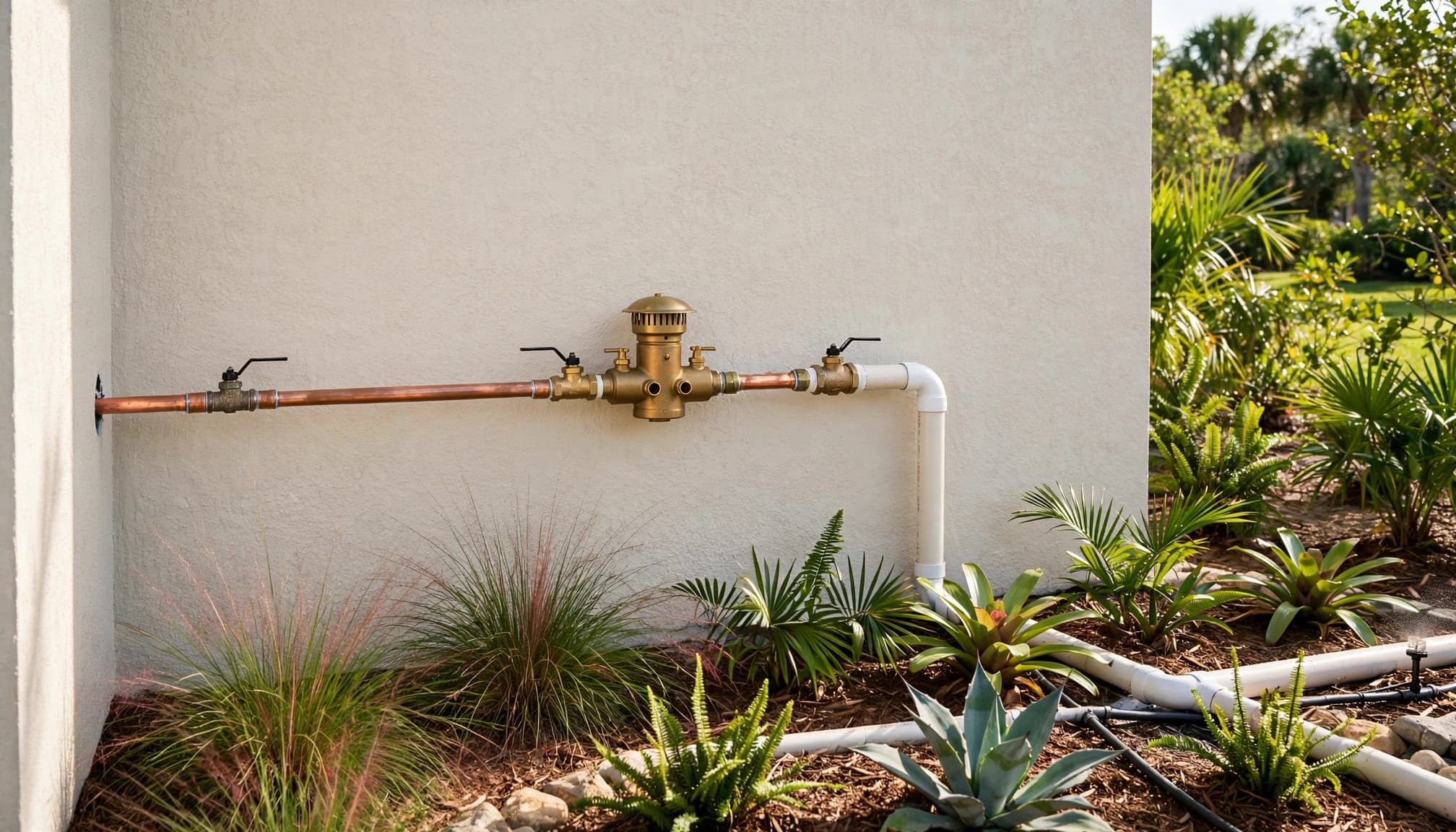
The City's Section 15100 requires private backflow assemblies to appear on its approved equipment list. Its specifications place them on the customer's side of the water service, just behind the right-of-way or easement.
The document also calls for above-ground placement in an insulated box and maintenance at the customer's expense.
These are requirements for assemblies covered by that specification. They don't establish one universal irrigation device for every custom home. Choosing equipment solely because a neighboring house has it can produce the wrong installation for your service arrangement.
Lee County Utilities cross-connection requirements
Lee County Utilities' Cross-Connection Control Policy, revised April 2025, requires approved assemblies for actual or potential cross-connections to its potable system.
Under that program, customers pay for testing and maintenance. Testing reports go through BSI Online, and the tester must provide the owner and LCU an approved Test and Maintenance Report within seven calendar days after the field test.
Those are LCU program requirements , not rules to automatically apply to City customers. Likewise, the permitting jurisdiction doesn't, by itself, identify the water provider.
Plan the Assembly Before Landscaping and Concrete
For our custom-home projects, irrigation belongs in the same planning conversation as household plumbing, drainage, and outdoor living spaces. Equipment locations become harder to change once walkways, planting beds, and pool decks are installed.
Before equipment selection, have the serving water utility or authority and a licensed plumbing professional confirm the property's required protection. Give them the proposed water source, irrigation layout, and any planned fertilizer-injection equipment.
Then document the selected assembly, connection location, installation responsibilities, and required testing in the construction scope. Your plumbing layout before rough-in should account for those connections before piping routes become fixed.
Leave practical access for shutoff, inspection, testing, and repairs. Dense shrubs, fences, or decorative screening shouldn't block the assembly. Also, coordinate its location with grading and drainage rather than treating it as leftover yard space.
During preconstruction planning for a custom home, assign responsibility for permit submissions, inspections, test documentation, and homeowner handoff. A clear scope helps prevent equipment installation from being mistaken for completion of every approval requirement.
Frequently Asked Questions
Is a regular check valve enough for irrigation?
A basic check valve isn't automatically an acceptable substitute for an approved backflow assembly. Device capabilities differ.
For example, a pressure vacuum breaker protects against backsiphonage, while a reduced-pressure assembly addresses backsiphonage and backpressure. However, that general distinction doesn't determine which assembly your utility accepts for the proposed installation.
Does a separate irrigation well eliminate backflow concerns?
A separate well changes the configuration, but drinking-water piping still needs protection from cross-connections. Don't add a direct connection between the well and municipal water piping.
An irrigation pump also changes system pressure conditions. Therefore, the plumbing design needs to account for the pump and any proposed backup water connection.
What records should the homeowner keep?
Keep the approved installation information, equipment identification, inspection results, and applicable backflow test reports with the home's construction records.
For LCU-covered assemblies, retain the owner's copy of the Test and Maintenance Report. These records help future plumbers identify the equipment and distinguish completed testing from ordinary irrigation repairs.
Build Backflow Protection Into the Original Plan
A custom home's irrigation backflow preventer should match its water source, cross-connection risk, and serving utility's requirements. City specifications and LCU policies shouldn't be treated as interchangeable.
Resolve the protection method before installation, then preserve access and keep the required records. Early coordination makes safe water separation part of the finished home rather than a correction after landscaping.