Estero Construction Material Lead Times: What to Order First
Explore Our Services
Contact Us Today!
(239) 322-9295
An empty lot can look ready long before a house can start. In Estero, construction material lead times depend on supplier inventory, product approvals, permit review, factory capacity, weather, and delivery access.
When windows, trusses, roofing, cabinets, or pool equipment arrive late, crews may stop or work out of sequence. A reliable ordering plan connects design decisions to permits, framing, inspections, and secure storage. Start with the items that control the schedule, not the products that are easiest to buy.
How construction material lead times work in Estero
There is no single lead-time calendar for every Southwest Florida home. A product in stock at a local distributor may arrive within days, while a custom item may require engineering, factory production, approval documents, and scheduled freight.
Project specifications also change the timeline. A standard window size may be available sooner than an oversized impact unit. Custom roof shapes can affect truss engineering. Imported tile, specialty cabinets, and made-to-order shower glass may require additional production and shipping time.
Permitting adds another variable. The Village of Estero requires permits for regulated electrical, gas, mechanical, and plumbing work, along with other construction activities covered by the Florida Building Code. Permit review comments can change dimensions, elevations, fastening details, or product selections after an initial order.
Current planning references show how wide the range can be:
- Windows and exterior doors often run about 8 to 12 weeks, with custom products taking 16 weeks or longer.
- Trusses and engineered lumber commonly require about 6 to 8 weeks.
- Standing seam metal roofing can take 12 to 18 weeks.
- Roofing membranes may take 3 to 10 weeks, depending on product and inventory.
- Concrete and masonry materials may fall within a 1 to 4 week planning range.
- Semi-custom cabinets in Southwest Florida often take 4 to 8 weeks. Custom cabinets may require 8 to 12 weeks.
- Imported or handmade tile can take 6 to 12 weeks.
- Made-to-order shower glass often takes 3 to 6 weeks after field measurements.
These figures are planning ranges, not promises. The supplier should confirm the current production queue, approval status, shipping method, and expected delivery window for your exact product.
What to order first for an Estero new construction project
The first orders should support the building shell and framing schedule. However, ordering early doesn't mean sending every product to the jobsite immediately. Buy or release materials when the design is fixed and you have a safe place to store them.
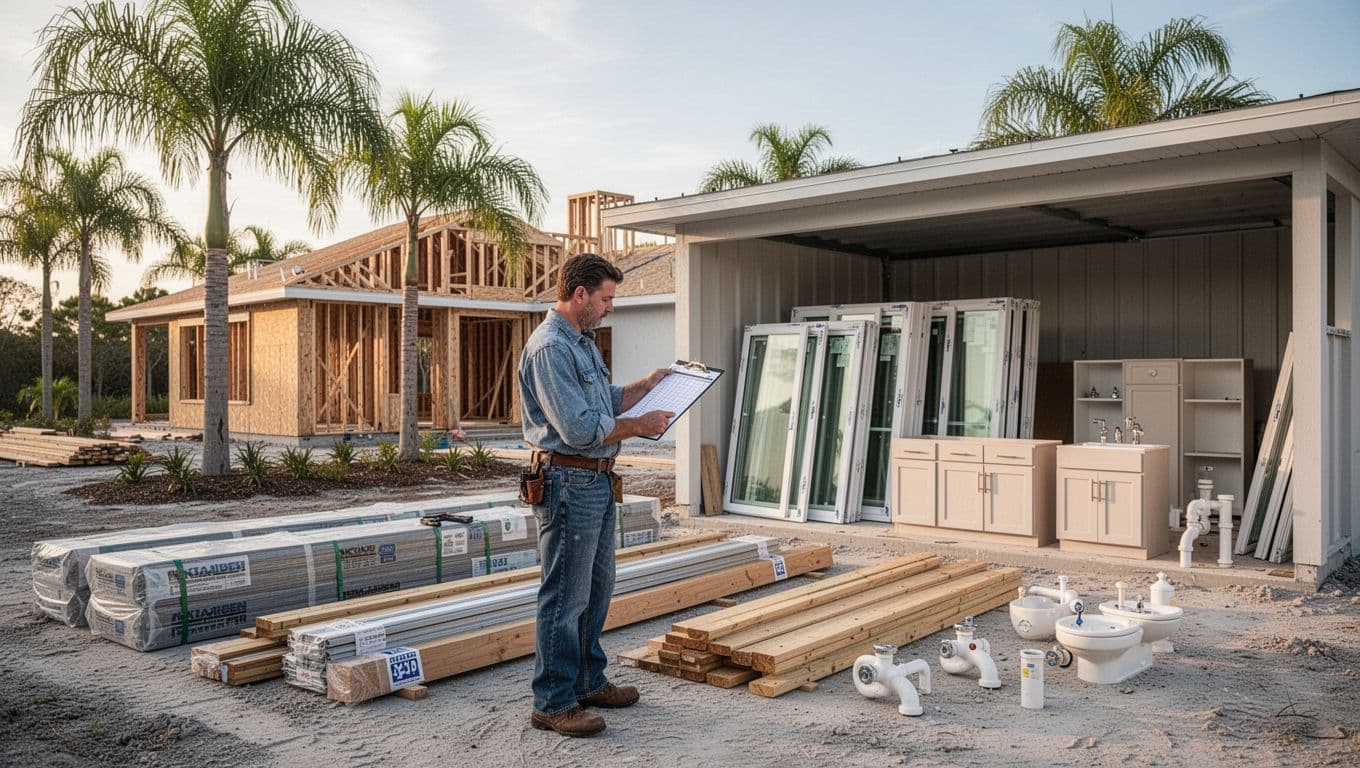
Use the longest realistic lead time when setting your procurement dates.
| Material or decision | Common planning range | When to address it |
|---|---|---|
| Impact windows and exterior doors | 8 to 12 weeks typical | Confirm sizes, approvals, and wind pressures before framing |
| Trusses and engineered lumber | 6 to 8 weeks | Release after structural plans and loads are approved |
| Standing seam metal roofing | 12 to 18 weeks | Coordinate with roof geometry and final sheathing details |
| Roofing membrane systems | 3 to 10 weeks | Confirm system approval, uplift rating, and installation method |
| Semi-custom cabinets | 4 to 8 weeks | Finalize after the kitchen layout and appliance locations are fixed |
| Custom cabinets and imported tile | 8 to 12 weeks or longer | Select early, then schedule delivery for protected storage |
Windows, exterior doors, and trusses usually deserve the earliest attention on a custom single-family home. Framing cannot proceed efficiently when the opening schedule or engineered roof package remains unresolved.
Roofing deserves early review, even when the final order comes later. The roof shape, underlayment, fasteners, uplift ratings, and selected covering must work together. If you plan a pool, large lanai, generator, or extensive backyard project, coordinate underground utilities and access before grading or slab work. Pool equipment may also need early selection when electrical, gas, automation, or plumbing layouts depend on it.
Decisions to make before permits and framing
A material order should follow a clear design decision. Ordering first and resolving the details later creates change orders, storage problems, and possible permit corrections.
Before the permit package is submitted, confirm these items with the designer, engineer, and builder:
- The site plan shows finished floor elevation, drainage, setbacks, access, and any flood-related requirements.
- The window, door, garage door, shutter, and skylight schedule lists exact sizes, models, design pressures, and approval documents.
- The truss package matches the roof geometry, mechanical equipment, attic loads, ceiling plans, and connector details.
- The roof assembly includes the correct sheathing, underlayment, fasteners, covering, and uplift ratings.
- Plumbing, electrical, HVAC, gas, pool, and low-voltage routes are coordinated before walls and slabs close.
- Finish selections match the cabinet layout, appliance specifications, plumbing trim, tile thickness, and shower dimensions.
Estero flood-hazard requirements can affect finished elevations, door thresholds, window sill heights, and final opening dimensions. Those details need approval before ordering exterior openings.
Code-cycle timing also matters in 2026. Florida legislation directs stronger impact-resistance and wind-resistant envelope requirements for certain buildings and coastal residences when the applicable 9th Edition Florida Building Code provisions take effect. Current code guidance identifies December 31, 2026, as the effective date for that edition. Confirm the permit date and project category with the building official and design team before selecting products.
For windows, doors, roofing, shutters, and other exterior components, review the exact approval path before purchase. This Florida product approvals guide for Southwest Florida permits explains why a product that looks similar may not satisfy the approval listed in the plans.
Estero Ordinance No. 2026-01 also affects certain building types. New hotels, motels, commercial buildings, and multifamily buildings covered by the ordinance require concrete exterior walls with the reinforcement specified by the project engineer or Florida Building Code. That requirement changes the procurement plan compared with a wood-framed single-family home.
How to confirm delivery dates in writing
A verbal estimate is not a construction schedule. Ask each supplier to identify what starts the lead time and what could restart the clock.
The written confirmation should include:
- The exact manufacturer, model, size, finish, color, quantity, and approval reference.
- The date the supplier considers the order released, especially if production waits for approved drawings or a deposit.
- The estimated production completion date, ship date, and delivery window.
- Any conditions that can delay shipment, such as unresolved shop drawings, missing engineering, limited inventory, or factory closures.
- The delivery requirements, including truck access, unloading equipment, site contact, driveway limits, and weather restrictions.
- The cancellation, storage, damage-claim, and price-change terms.
Keep the supplier confirmation with the project schedule. Build the schedule around the need-by date , not only the date a salesperson expects to ship.
A current Lee County permit-planning reference lists residential new-construction plan review at roughly 10 to 15 business days, while some roofing and trade permits may move faster. Those figures don't account for corrections, resubmittals, engineering changes, or workload spikes. Leave room for review before releasing products tied to the approved plans.
Delivery conditions matter in Estero. Summer storms, hurricane season, roadwork, traffic controls, and narrow residential streets can delay oversized loads even when the material is ready. Trusses, windows, doors, and roofing bundles need a delivery plan that accounts for the truck, unloading space, ground conditions, and the home's construction stage.
Protect materials before installation
Early delivery only helps when materials remain usable. A Florida jobsite exposes products to heat, humidity, rain, wind, insects, and theft.
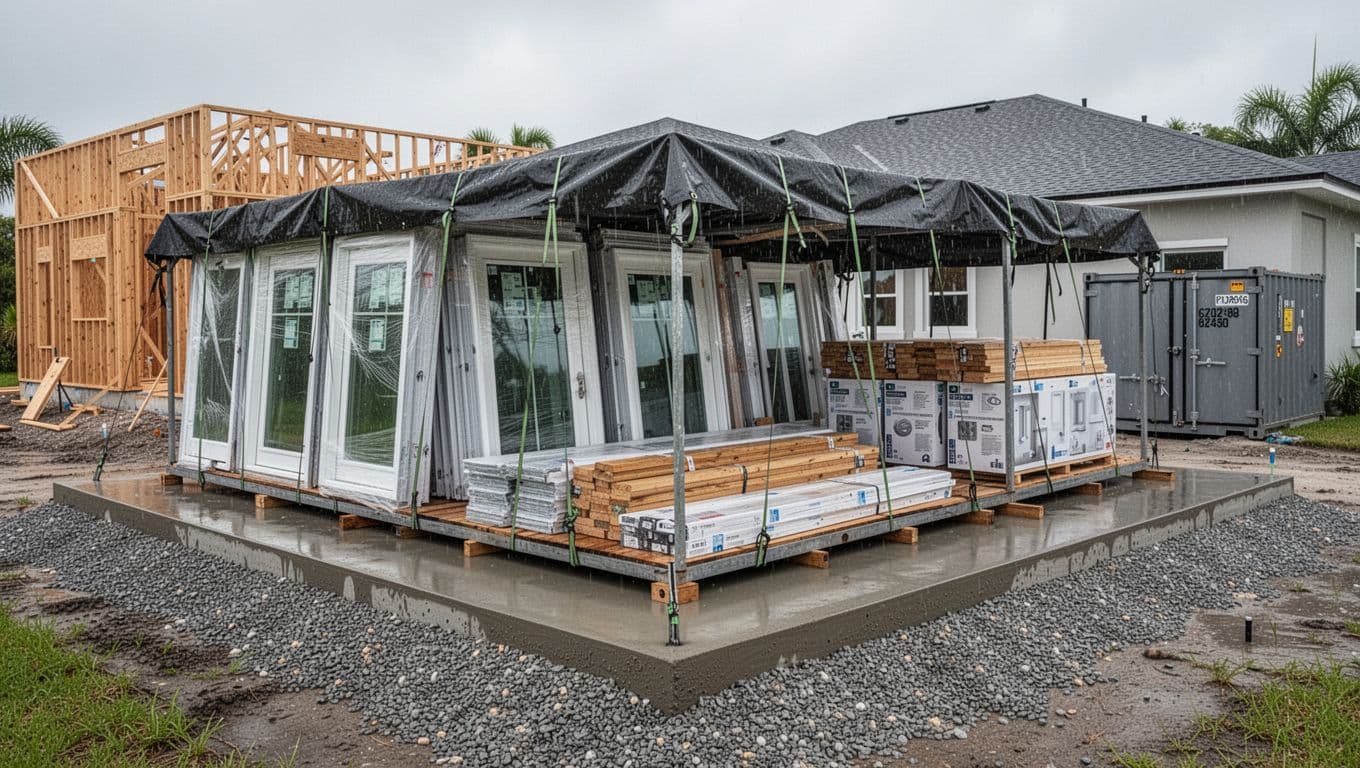
Store lumber off the ground with air circulation between layers. Avoid sealing damp wood under plastic, because trapped moisture can lead to staining, swelling, or mold. Keep windows and doors upright when the manufacturer requires it, and protect them from impact during other site work.
Roofing materials should sit on stable, level supports. Tarps need to shed water without trapping condensation. Cabinets, flooring, tile, plumbing fixtures, appliances, and electronics belong in a locked, dry area with conditions suitable for the manufacturer's storage requirements.
Before accepting a delivery, photograph packaging, labels, visible damage, and the quantity received. Record shortages immediately. A fenced site, locked storage container, lighting, cameras, and controlled access can reduce theft, but expensive materials should still arrive close to installation whenever possible.
Handle substitutions without compromising the design
A supplier may offer a substitute when the selected product is delayed. That option can help, but appearance alone isn't enough for approval.
For an exterior product, compare the exact Florida Product Approval or Miami-Dade Notice of Acceptance, approved size limits, design pressures, impact rating, installation method, glass type, energy requirements, egress requirements, and warranty. A different window may require different rough openings or fastening details.
Roofing substitutions require the same care. Check the full assembly, including underlayment, fasteners, clips, edge metal, uplift rating, fire classification, compatibility, and installation instructions. Changing one component can affect the approval of the entire roof system.
Put every proposed substitution in writing. The designer, engineer, builder, and building official may need to review revised shop drawings or permit documents before installation. Confirm the price difference, schedule effect, warranty, and any changes to rough-ins or finishes.
A close visual match is not automatically a code-compliant substitute. The approval must match the product, size, installation method, and project conditions.
Plan around the longest lead time
The safest ordering plan starts with the materials that control framing and enclosure. For many Estero homes, that means resolving the opening schedule, trusses, roof system, and code approvals before selecting later finishes.
Construction material lead times become easier to manage when every order has a written release date, need-by date, approval reference, delivery plan, and storage location. That system gives homeowners and builders a clear response when a supplier changes the schedule.
The goal isn't to order everything as early as possible. It is to make the right decisions early, release long-lead products at the proper point, and keep them protected until the crew is ready to install them.