


Build in Southwest Florida long enough and you'll hear the same sentence in ten different ways: "What's the finished floor elevation?" That one number can decide your foundation type, driveway layout, stair count, and sometimes whether your plans sail through permitting or get kicked back.
In plain terms, finished floor elevation (FFE) is the height of your home's living floor compared to a known vertical reference. In a flat, wet region with coastal surge and heavy rainfall, getting it right matters as much as the floor plan.
Quick disclaimer: This is general education, not engineering or legal advice. Always confirm requirements with your local building department and floodplain manager, and follow your surveyor and engineer's sealed documents.
What "finished floor elevation" really means on a Southwest Florida lot
Think of FFE like setting the rim of a bathtub. If the rim sits too low, the first big splash goes over the edge. In Southwest Florida, "the splash" can be storm surge, canal overflow, sheet flow after a tropical downpour, or water that simply can't drain fast enough because the ground is so flat.
FFE is not the same as "how high the dirt is." Your lot might be built up with fill, but the value that matters for flood compliance is the elevation of the finished living floor (and in flood zones, the definition of "lowest floor" can get technical fast).
Here's a quick vocabulary table that makes the rest of this easier.
| Term | Plain-language meaning | Why it matters |
|---|---|---|
| Benchmark | A known elevation point your survey ties into | Keeps everyone working from the same "zero" |
| Datum (NAVD88) | The vertical reference used for mapping elevations | Prevents costly mix-ups between old and new references |
| BFE (Base Flood Elevation) | FEMA's modeled 1 percent annual chance flood elevation | Sets the baseline for floodplain design |
| Freeboard | Extra height added above BFE | Adds buffer, can reduce flood risk and insurance costs |
| DFE (Design Flood Elevation) | BFE plus required freeboard (and any other local rules) | The target elevation many plans must meet |
| FFE (Finished Floor Elevation) | Height of the finished living floor | Affects foundation height, access, and budget |
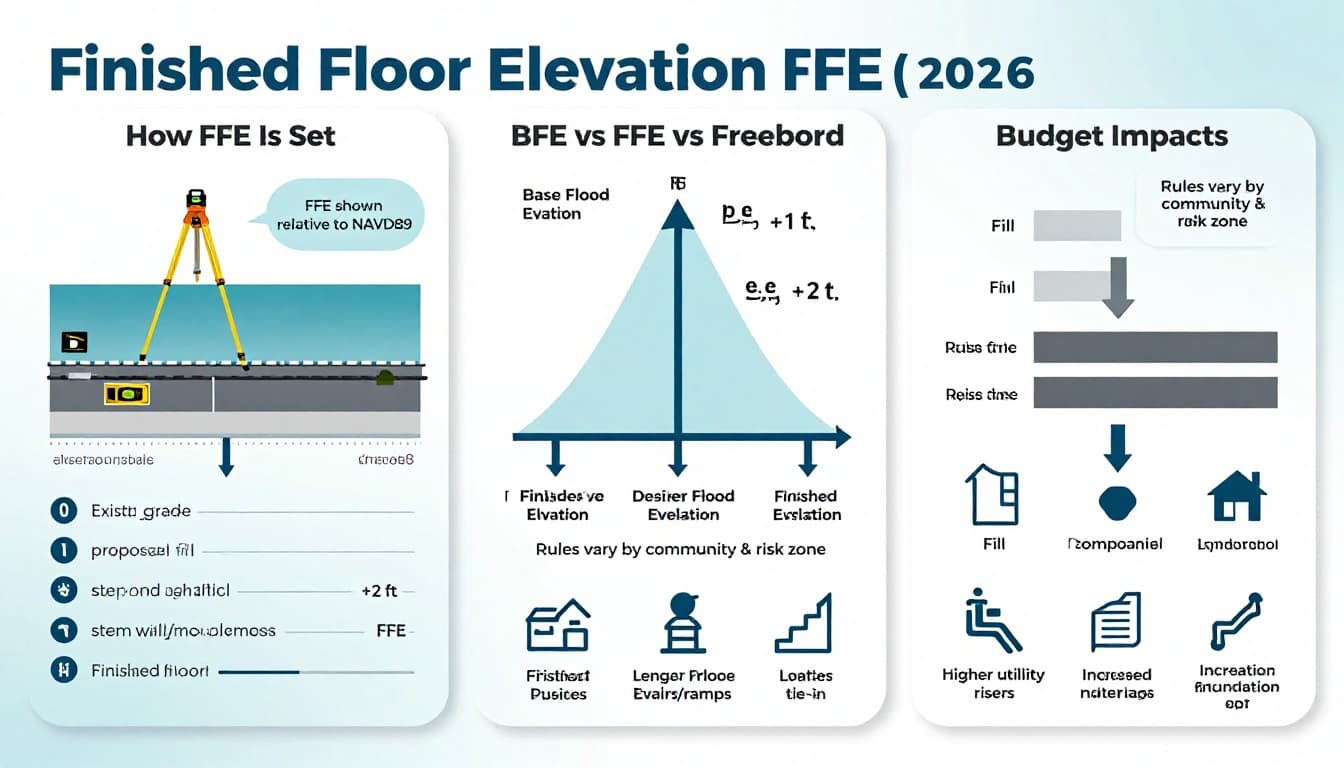 Infographic showing how FFE is established, how freeboard stacks above BFE, and where the budget usually shifts, created with AI.
One more real-world point: FFE isn't only about flooding. A higher floor changes grading, driveway slope, and how water moves across the yard. If you've ever watched water sit in a swale for hours after a summer storm, you already get the stakes.
For broader planning context, it helps to read a local overview like this guide to building dream homes in Southwest Florida, then come back to elevation with better questions.
How FFE is set (plain steps first, then the technical notes)
Most homeowners picture FFE as a builder choice. In reality, it's a chain of decisions that starts with surveys and ends with a permit set. Each link has to match, or you pay to fix it later.
The plain-language flow
First, a surveyor establishes elevations on your lot using benchmarks. Next, your designer and engineer pick a target FFE that meets flood rules (if applicable) and works with drainage and driveway tie-ins. Then the foundation design locks that elevation in, whether that's a monolithic slab, a stem wall, or piles in higher-risk coastal areas.
After that, your grading plan matters just as much as the slab. The dirt has one job: move water away without dumping it on a neighbor.
The technical notes that trip people up
- Datum and map panels : Make sure everyone is using the same vertical datum (often NAVD88). Small datum mistakes can create big field problems.
- Elevation Certificate : Even if you're not required to carry flood insurance, an Elevation Certificate can be valuable for documentation and future buyers. It also helps your insurance agent rate the home correctly.
- Benchmark control : Ask where the benchmark is and how it's referenced. That's boring until it isn't.
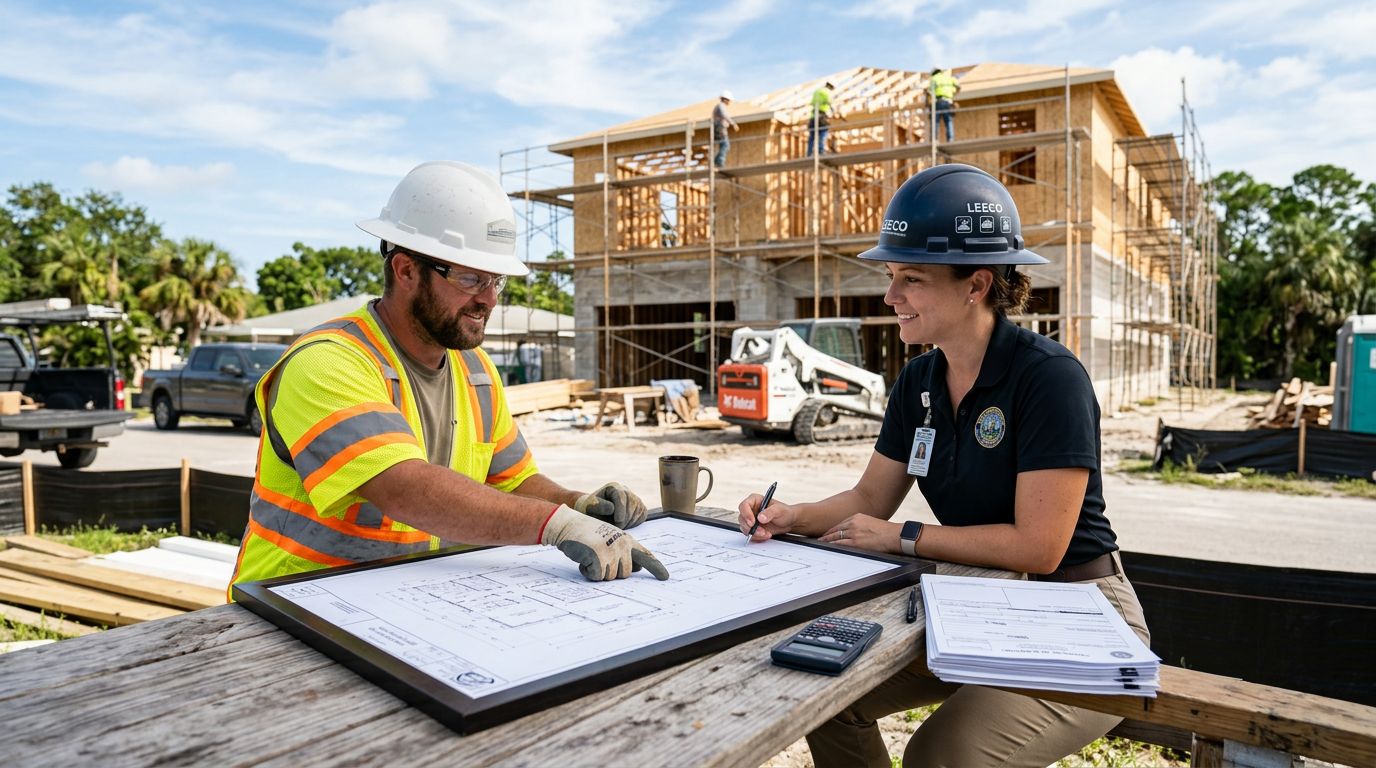
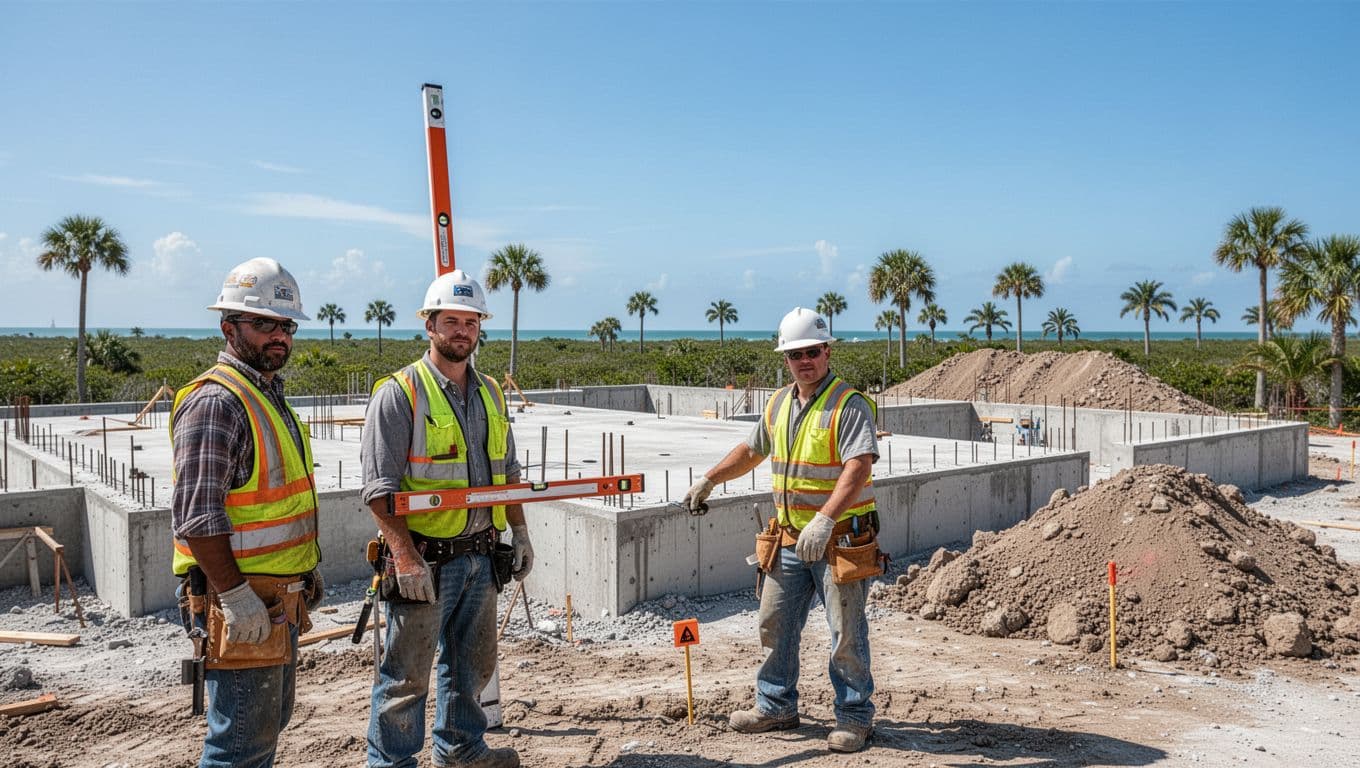 Elevated foundation work in progress, with survey and layout happening alongside site prep, created with AI.
Access planning should happen now, not after concrete. A higher FFE usually means more steps, longer runs, or a ramp strategy. If anyone in the household needs an accessible route, talk early about slopes, landings, and where that path will actually go. ADA-style ramps often target a 1:12 slope with landings, but your site, layout, and local reviews will drive the final design.
Field-proven tip: If you wait until framing to think about stairs and driveway slope, you'll end up "solving" it with expensive rework.
2026 freeboard rules in Southwest Florida, and why higher FFE changes the budget
In February 2026, many Southwest Florida communities in SFHAs (flood zones that start with A or V) commonly require at least 1 foot of freeboard above the mapped BFE for new construction and substantial improvements. However, maps and ordinances can change, and FEMA map updates can shift BFEs in pockets of Lee and Collier, so always verify what applies to your exact parcel before you finalize plans.
Also, financing can add another layer. Some federal loan programs have used higher freeboard standards in certain cases (for example, 2 feet in SFHAs for specific loan types). Even if your municipality doesn't require it, your lender or insurer might care.
Now the money question: what does a higher FFE do to your budget? Rarely just one line item. It's more like raising the entire house on a thicker stack of books, everything connected moves with it.
Here are the cost drivers that show up most often (amounts vary by site conditions and market).
| When FFE rises, these items often rise too | What changes in the build | Typical budget effect (market-dependent) |
|---|---|---|
| Fill, compaction, and testing | More material, more trucking, more proof it's compacted | Low to high |
| Taller stem wall or foundation system | More concrete, block, steel, labor | Medium to high |
| Driveway tie-in and slope control | Longer driveway run, more grading, possible right-of-way details | Low to medium |
| Steps, landings, and railings | More carpentry, concrete, or masonry, plus permitting details | Low to medium |
| Utilities and equipment elevation | Higher risers, hanging platforms, revised routes | Low to medium |
| Drainage and swales | More shaping, sometimes more structures | Low to high |
A few practical callouts that affect both comfort and approvals:
- Driveway slope limits : Many jurisdictions review driveway grades near the street and garage for safety and drainage. A steep driveway can scrape bumpers and push water toward the slab. Ask your civil engineer what maximum slopes and transitions apply where you're building.
- Garage floor vs living area : In flood zones, the garage often sits lower than the living floor, and rules may restrict what can go below the design flood elevation. That choice affects steps into the house and how you store items.
- HVAC and water heater elevation : Plan where equipment goes so it's protected and serviceable. Moving mechanicals higher can affect duct runs, closets, and attic access.
- Drainage and swales : Raising the pad changes how runoff behaves. Your grading plan should direct water away from the foundation while respecting swales and easements.
This is where working with a cost-plus home builder can reduce stress, because you can see the true impacts as elevation decisions ripple through sitework and foundation scope. Pair that with transparent pricing and you can track the "why" behind changes, instead of guessing where the budget went.
If you're weighing new construction paths, this comparison of custom vs spec homes in Southwest Florida is a good way to frame who controls elevation decisions, and when.
Conclusion: Set FFE early, confirm it often
In Southwest Florida, finished floor elevation is a safety choice, a permitting requirement in many flood zones, and a budget driver all at once. Start with current maps and a good survey, confirm freeboard expectations in writing, and treat drainage and access as part of the elevation plan, not add-ons.
If you take one next step, make it this: get comfortable reading the benchmark notes and the Elevation Certificate, then confirm the target FFE with your building department and floodplain manager before you lock your foundation. The easiest elevation problem to fix is the one you never build.