Fresh Air Ventilation for New Bonita Springs Homes
Explore Our Services
Contact Us Today!
(239) 322-9295
A tightly sealed home can save energy, but it also changes how indoor air moves. Fresh air ventilation gives a new Bonita Springs home a controlled way to remove stale air and bring in outdoor air without relying on random leaks around windows and doors.
That outdoor air arrives hot, humid, and sometimes salty. The right system must work with the air conditioner, filtration, and humidity controls rather than operate as an isolated add-on. Before construction begins, ask how the home will meet Florida's ventilation requirements and stay comfortable during Southwest Florida's wettest months.
How fresh air ventilation works in a new Florida home
Modern construction reduces unwanted air leakage around the building envelope. Better windows, sealed penetrations, insulation, and weather-resistant assemblies help the home use less energy. However, the same tightness reduces the amount of outdoor air entering on its own.
Tight construction needs a planned air exchange
Cooking, bathing, cleaning, and normal occupancy add moisture and odors indoors. Without a planned exchange, those pollutants can remain trapped for longer periods.
Opening windows can help, but it isn't a dependable daily strategy in Bonita Springs. Outdoor humidity, rain, pollen, insects, security concerns, and air-conditioning costs make open-window ventilation impractical for many homeowners.
A mechanical system brings in a measured amount of outdoor air and sends stale air outside. Depending on the design, it may use separate supply and exhaust ducts, the central air handler, or an energy recovery ventilator.
Ventilation is different from air leakage
Accidental leakage is uncontrolled. Air can enter through an attic hatch, plumbing penetration, duct connection, or poorly sealed window opening. You don't know how much air is moving, where it comes from, or whether it passes through a filter.
Mechanical ventilation gives the builder and HVAC contractor a defined airflow rate. It also creates a serviceable system with an intake location, controls, filters, and ducts that professionals can inspect.
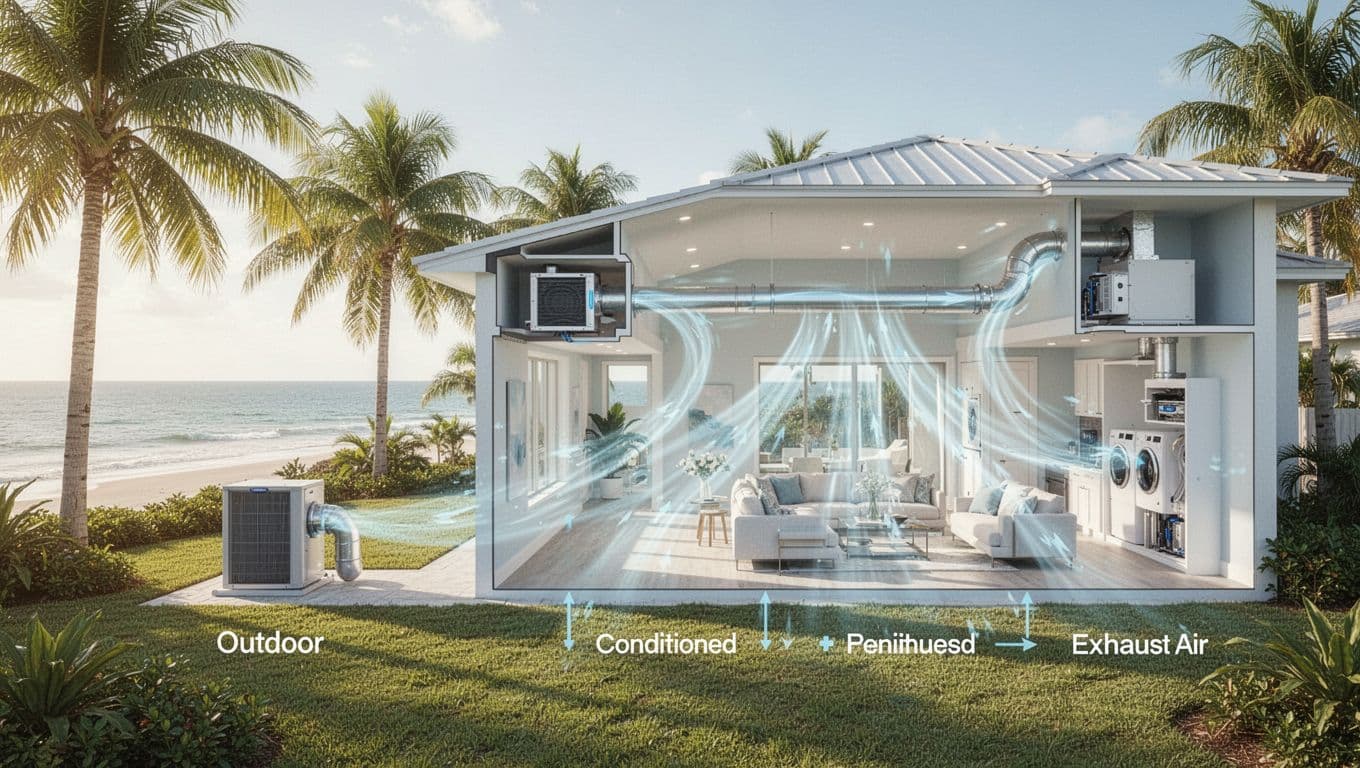
Controlled outdoor-air exchange helps a tightly sealed home maintain better indoor air quality.
Fresh air ventilation vs. AC, filtration, and dehumidification
These four functions often work together, but they solve different problems. Confusing them can lead to a system that keeps the temperature comfortable while leaving the air damp or stale.
Air conditioning controls temperature
An air conditioner cools indoor air and removes some moisture when the equipment runs. It mainly recirculates the air already inside the home.
The AC system won't automatically provide the required amount of outdoor air unless the design includes a dedicated intake and appropriate controls. A fresh-air duct connected to the return side of an air handler can be part of a compliant system, but its performance depends on airflow, runtime, duct sealing, and moisture control.
Equipment sizing also matters. An oversized unit may cool the house quickly without running long enough to remove adequate humidity. A qualified HVAC professional should complete a residential load calculation before selecting the equipment.
Filtration removes airborne particles
A filter catches particles that pass through it. Depending on the filter and system design, that can include dust, pollen, pet dander, and some fine particles.
Filtration doesn't replace ventilation because a filter doesn't exchange indoor and outdoor air. It also doesn't remove water vapor. Ask whether the outdoor-air path has its own filter or connects to a filtered return system.
The filter must fit the air handler and the duct design. A high-efficiency filter can restrict airflow if the equipment wasn't designed to handle its resistance. Ask what filter size and rating the contractor proposes, and how often you should replace it.
Dehumidification removes moisture
A dehumidifier lowers indoor humidity when the AC doesn't run long enough to do the job. This matters during mild but muggy weather, when the home may reach its temperature setting without removing enough moisture.
A whole-home unit can connect to the HVAC duct system and manage humidity throughout the house. Review the expected equipment and installation costs in this guide to whole-house dehumidifier costs in Southwest Florida.
A dehumidifier doesn't bring in outdoor air. It needs a separate ventilation strategy, although the two systems can share controls.
A home can reach its thermostat setting and still feel damp. Temperature control and moisture control are separate parts of the HVAC design.
Which ventilation approach fits Bonita Springs?
The best choice depends on the home's size, air-sealing plan, duct layout, occupancy, and humidity strategy. Florida's code allows more than one approach, so the contractor should explain the design instead of presenting a single product as a universal answer.
ERV or HRV?
An energy recovery ventilator, or ERV, exchanges heat and transfers some moisture between incoming and outgoing air. That can reduce the moisture burden that comes with bringing humid outdoor air into the home.
A heat recovery ventilator, or HRV, transfers heat but generally doesn't transfer moisture in the same way. HRVs are often more useful in cold climates, where dry indoor air is a concern. In Bonita Springs, an ERV often fits the climate better because indoor humidity control is a major concern.
An ERV still isn't a substitute for proper air conditioning or dedicated dehumidification. Ask for the unit's tested airflow, sensible recovery performance, and latent recovery rating. Florida Building Commission energy materials include performance criteria for applicable ERV and HRV measures, so the selected equipment should match the approved design.
Supply-only, exhaust-only, or balanced?
A supply-only system brings filtered outdoor air into the home. It can create slight positive pressure, which may help limit unfiltered infiltration when the ducts and envelope are well sealed.
An exhaust-only system removes indoor air and relies on replacement air entering through planned openings or minor leakage. Its performance depends on where that replacement air comes from.
A balanced system supplies and exhausts air at controlled rates. ERVs commonly use this arrangement, which helps reduce pressure imbalances and recovers part of the energy used to condition the air.
Each method can work when properly designed. For a new coastal home, ask how the selected system handles pressure, filtration, condensate, noise, and humidity during periods when the AC runs less often.
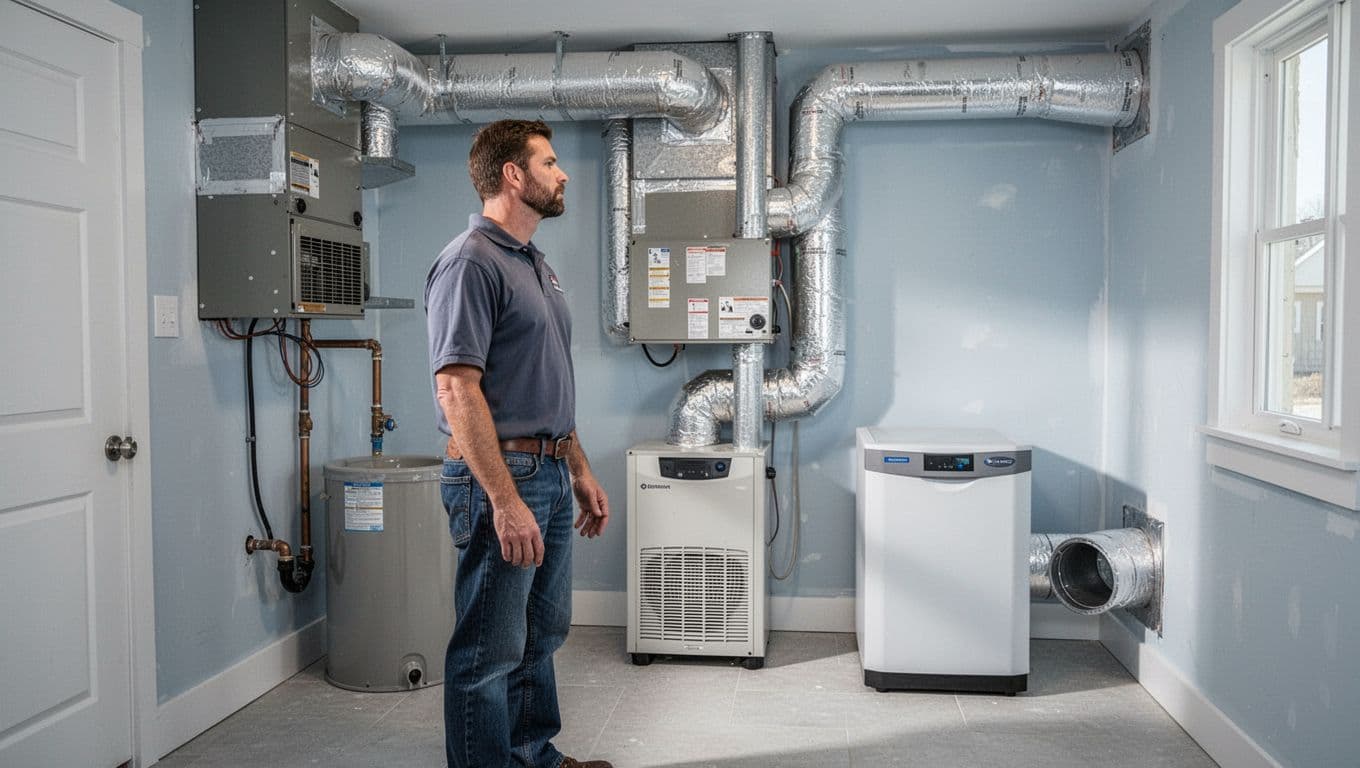
The ventilation system should leave room for access, filter changes, drain service, and future repairs.
Florida ventilation requirements to settle early
Code compliance is part of the design conversation, not a final paperwork task. The exact requirements depend on the code edition and project jurisdiction, so your builder and licensed HVAC professional should confirm the details for the permit.
Calculate the outdoor-air rate
Florida residential mechanical ventilation provisions use this formula:
QOA = 0.01 x conditioned floor area + 7.5 x (number of bedrooms + 1)
The result is measured in cubic feet per minute, or CFM. For example, a 2,000-square-foot home with three bedrooms would calculate as 20 CFM plus 30 CFM, for a total of 50 CFM before any applicable code adjustment.
The system generally must provide the required outdoor air continuously while occupied. The code also allows an operating method that runs at least one hour during each four-hour period while maintaining the required four-hour average airflow.
Ask for the actual calculation in the plans. A contractor should be able to show the home's conditioned floor area, bedroom count, selected equipment, and operating controls.
Plan the intake, ducts, and testing
The outdoor-air intake needs a clean location. Florida provisions generally require separation from contaminant sources such as exhaust outlets, streets, parking areas, and loading zones. The intake should also remain accessible for inspection and filter service.
Construction details matter. Ducts need proper insulation, sealing, support, and routing. Condensation can damage surrounding materials if humid air contacts cold surfaces or if drain lines lack the required slope and protection.
Ask how the contractor will verify airflow after installation. A startup report should document ventilation performance, filter installation, controls, condensate drainage, and equipment operation. A blower door test for a Southwest Florida new home checks the building envelope, while duct testing checks the HVAC distribution system. Neither test replaces the other.
Questions to ask your builder or HVAC contractor
A clear answer should include a design method, an airflow number, equipment information, and a testing plan. If the answer is only "the house will breathe" or "the AC handles it," ask for more detail.
Questions about the design
Ask these questions before the walls and ceilings hide the ductwork:
- What ventilation method will the home use, supply-only, exhaust-only, balanced, ERV, or HRV?
- What is the calculated outdoor-air rate in CFM for this floor plan?
- Will the ventilation run continuously or on a timed schedule?
- Where will the outdoor-air intake sit in relation to the garage, driveway, pool equipment, dryer vent, plumbing vents, and exhaust outlets?
- Will incoming outdoor air pass through a filter before entering the living areas?
- How will the system control humidity when outdoor air is hot and wet?
- Does the home need a whole-house dehumidifier?
- What filter size and rating can the air handler support without reducing airflow?
- What noise level should you expect in bedrooms and common areas?
- Which controls will operate the ventilator, air conditioner, and dehumidifier together?
These answers also help you compare proposals. Two systems may have similar equipment names but very different duct layouts, controls, service access, and moisture performance.
Questions about installation and handoff
Ask the builder to show the ventilation ducts during the rough-in stage, before insulation and drywall cover them. Look for clear access around the equipment, sealed connections, insulated sections, and a drain arrangement that protects the structure.
Request the equipment model numbers, installation instructions, filter details, control settings, and warranty information at closeout. Ask who will adjust the system if indoor humidity stays high or airflow doesn't match the design.
Budget the equipment early. In 2026, a complete HVAC installation for many 1,500 to 2,500-square-foot Southwest Florida new homes falls around $10,000 to $18,000, including equipment, labor, and ductwork, according to Southwest Florida new construction HVAC cost estimates. Ventilation and dehumidification may be integrated into that package or priced separately.
Finally, confirm that equipment sizing, installation, testing, permits, and code compliance will be reviewed by qualified local professionals. Bonita Springs' coastal conditions call for a design that handles moisture as carefully as it handles temperature.
Conclusion
A new Bonita Springs home needs more than a tight shell and a powerful air conditioner. Fresh air ventilation should deliver measured outdoor air, remove stale air, protect indoor humidity, and work with filtration and cooling controls.
Ask for the airflow calculation, intake location, equipment type, humidity plan, and commissioning report before construction reaches the drywall stage. When the system is sized and installed correctly, the home can stay sealed for efficiency without leaving indoor air quality to chance.