Fort Myers Roofing Contract Checklist Before You Sign
Explore Our Services
Contact Us Today!
(239) 322-9295
A new roof can protect your Fort Myers home for decades, but a weak contract can create problems before the first shingle comes off. A clear roofing contract checklist helps you compare bids, protect your budget, and avoid post-storm sales pressure.
Florida roofs face punishing sun, wind-driven rain, humidity, and hurricane exposure. Before you sign, the agreement should show exactly who is doing the work, what they will install, who handles permits, and what happens if hidden damage appears.
Verify the contractor before reviewing the price
A low price means little if the contractor cannot lawfully perform the work or cannot cover a jobsite accident. Start with the company behind the proposal.
Match the business name to the license
Confirm that the legal business name on the contract matches the name on the contractor's Florida license and insurance paperwork. A roofing contractor should hold the proper active Florida license, and a state-licensed contractor working in Lee County must also meet local registration requirements.
Ask for the license number, then verify its status through Florida's contractor licensing records. Check for the contractor's exact license classification, current status, and any listed disciplinary history.
Also review who will perform the work. The contract should identify the contractor, not only a salesperson or marketing company. If subcontractors will handle tear-off, installation, or cleanup, the agreement should say who supervises them.
Request current insurance certificates
Ask for current certificates showing general liability coverage and workers' compensation coverage, or a valid workers' compensation exemption where applicable. The policyholder name should match the contracting business.
Lee County's roofing permit process requires contractors to maintain current liability and workers' compensation documentation. Don't accept a verbal assurance that coverage exists.
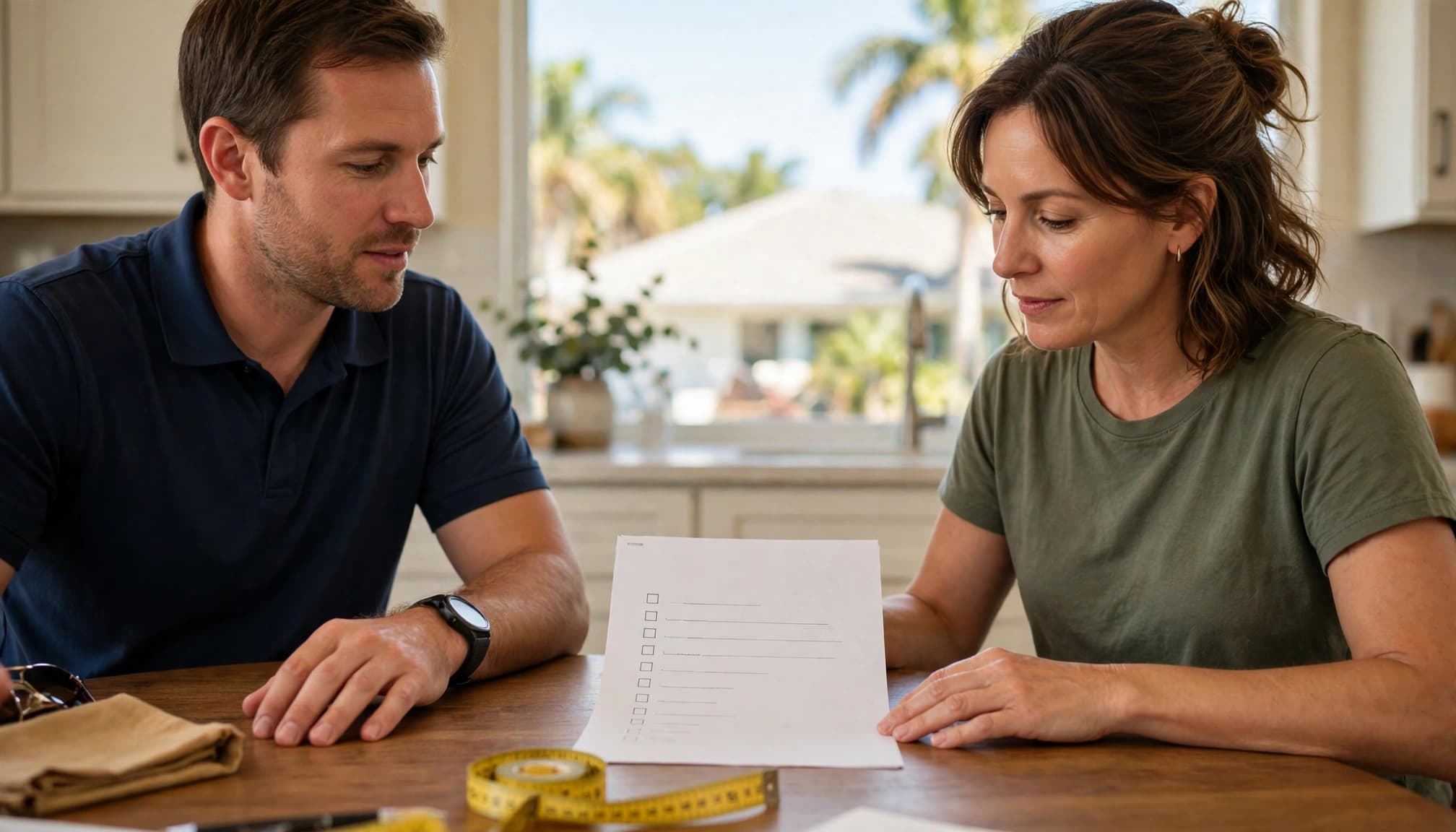
Insurance paperwork protects more than the roof. It helps clarify who bears responsibility if a worker, vehicle, or falling material damages your property.
Use a roofing contract checklist to define the work
The proposal should read like a work plan, not a vague promise to "replace roof." Every roof system has layers, edges, penetrations, and transition points that affect water resistance.
Name the materials and roof system
Your contract should identify the manufacturer, product line, color, and type of roofing material. For shingle roofs, it should state the shingle model, underlayment, starter strip, ridge cap, and fastening method. Tile and metal roofs need the same level of detail.
It should also describe flashing at walls, chimneys, skylights, vents, valleys, and plumbing penetrations. In Southwest Florida, these details matter because wind-driven rain often finds the smallest gap.
Ask whether the quoted materials have Florida Product Approval or Miami-Dade product approval where required. The contractor should include applicable product documentation in the project file.
Address tear-off, decking, and hidden damage
The agreement should state whether the crew will remove the existing roof down to the deck. It should explain how they will handle old underlayment, nails, vents, and disposal.
Decking repairs deserve clear terms. Roofers cannot always see deteriorated plywood until they remove the old covering. Still, the contract should list the per-sheet price for replacement decking, the labor charge, and the approval process before extra work begins.
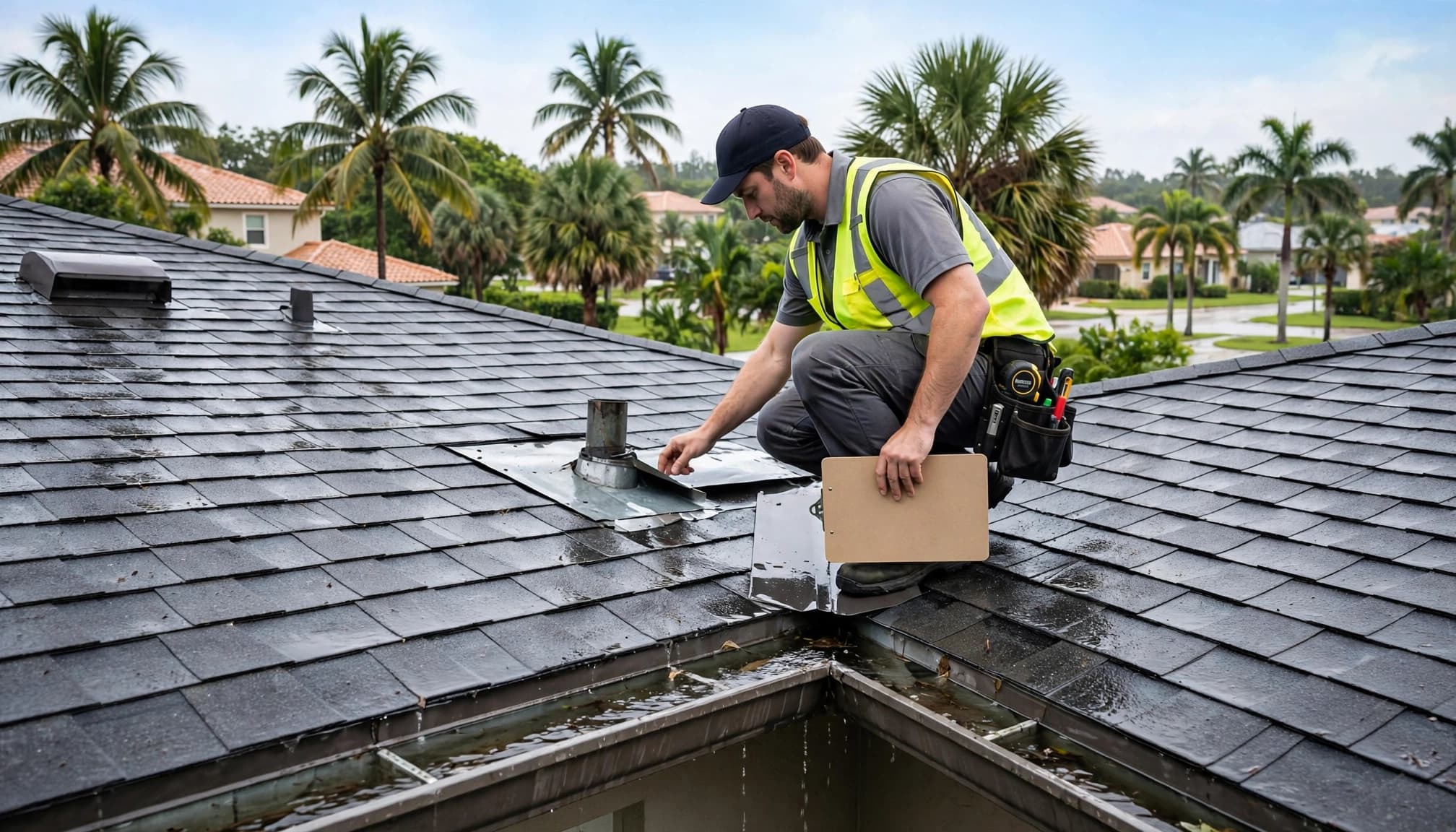
A complete scope should also mention drip edge, ventilation, gutter protection, attic access, satellite dishes, solar equipment, landscaping protection, and magnetic nail cleanup. If an item isn't written down, don't assume it is included.
Put permits and inspections in writing
Roof replacement is a permitted project in Lee County. A signed contract should make permit responsibility clear before work begins.
Identify who pulls the roof permit
The contractor should pull the permit in the contractor's name, not ask you to act as an owner-builder to avoid licensing rules. Owner-builder permits carry serious responsibilities and rarely make sense when you are hiring a roofing company.
The contract should state whether the quoted price includes permit fees, filing costs, inspection fees, and any required notices. It should also name the property address and describe the permitted scope accurately.
Fort Myers homeowners should confirm the jurisdiction for the home. Properties inside the City of Fort Myers and unincorporated Lee County may follow different local permit workflows, even though statewide construction standards apply.
Keep the closeout records
Ask for a complete project packet when the work is finished. Keep the signed contract, paid invoices, change orders, product approvals, permit information, final inspection record, warranty documents, and photographs.
These records can help with a future sale, insurance renewal, wind-mitigation review, or storm claim. They also provide proof of what sits beneath the visible roof covering.
Make the price, payment schedule, and changes understandable
A roof contract should give you a fixed base price and a plain explanation of what could change it. You should be able to track each dollar without reading between the lines.
Check the payment terms before making a deposit
Review the deposit amount, progress payments, and final payment trigger. Avoid schedules that require most of the money before materials arrive or work reaches a meaningful stage.
The agreement should state whether the price includes labor, materials, delivery, equipment, debris removal, permit costs, taxes, and final cleanup. If financing is involved, read the separate financing agreement as closely as the roofing contract.
Never rely on a promise that "we'll sort out the total later." A written quote should provide an itemized, good-faith estimate for labor and materials, especially when insurance is involved.
Separate insurance proceeds from your obligations
Your insurance carrier decides claim coverage. A contractor may inspect damage and provide an estimate, but the contract should not guarantee claim approval or promise an insurer will pay the entire price.
Florida law prohibits contractors from offering to waive, rebate, absorb, or otherwise cover an insurance deductible in exchange for work or a claim. Treat phrases such as "free roof," "no deductible," or "we'll handle your out-of-pocket cost" as warning signs.

Photo by Mikhail Nilov
If the project follows a storm claim, compare the insurer's scope with the contractor's scope line by line. Differences in decking, flashing, code upgrades, or disposal should be discussed in writing.
Account for Florida weather and jobsite protection
A roofing crew may need several days to complete a replacement. During that time, afternoon rain or a sudden tropical system can expose your home if the job is poorly managed.
Require a plan for rain and wind
The contract should explain how the crew will protect open roof areas overnight and during rain. Ask what temporary coverings they use, who monitors weather, and what happens if water enters the home during the project.
It should also address material storage. Bundles of shingles, tile pallets, and metal panels can damage driveways, pavers, pool decks, or landscaping if crews place them carelessly.
A good agreement identifies work hours, access points, dumpster placement, and protection for pools, screened lanais, air-conditioning equipment, and exterior finishes. If you have a solar array or rooftop equipment, confirm whether removal and reinstallation are included.
Read the warranty terms, not only the duration
A manufacturer warranty covers materials under its own conditions. The contractor's workmanship warranty covers installation. They are different promises.
Read the length of each warranty, what is excluded, who receives the claim, and whether the contractor will inspect a reported leak. Find out whether the warranty transfers if you sell the home.
A long warranty has little value if the contract does not identify the installed product, the installer, and the records needed to support a claim.
Watch for contract red flags after a storm
Hurricane season can bring legitimate roofing needs and aggressive sales tactics. A contractor who gives you time to review the agreement is easier to work with than one who demands an immediate signature.
Slow down when pressure replaces details
Be cautious if a salesperson arrives uninvited, claims every roof in the neighborhood qualifies for replacement, or insists that a signature is needed before you can ask questions. Do not sign a blank, incomplete, or partly filled-out agreement.
Residential roof repair or replacement contracts connected to a gubernatorial state-of-emergency event can carry a cancellation right. If you sign within 30 days after the covered event, Florida law generally allows cancellation without penalty within 10 days after signing or before the official start date, whichever comes first.
The signature page should also include the required insurance-verification notice in bold type. For residential contracts where labor and materials exceed $2,500, look for the Florida Homeowners' Construction Recovery Fund notice.
If any required notice is missing, stop and ask for a corrected contract. A missing disclosure does not make unclear terms acceptable.
Final Fort Myers roofing contract checklist
Before signing, confirm that the agreement includes each of these points:
- The contractor's legal business name, active Florida license information, and current liability and workers' compensation documentation.
- Your full property address, a detailed scope of work, exact roofing materials, flashing, underlayment, ventilation, and product approvals.
- Permit responsibility, permit fees, inspection steps, and a commitment that the contractor will pull the permit.
- A written base price, payment schedule, taxes, debris removal, and written approval requirements for decking or other added work.
- Clear rain protection, property protection, cleanup, warranty, and final closeout documentation terms.
- Required Florida notices, including insurance verification and the Construction Recovery Fund notice when the contract qualifies.
- No deductible-waiver language, vague insurance guarantees, blank spaces, or rushed signature demands.
Consult a qualified Florida construction attorney before signing if the contract includes a lien dispute, an assignment of benefits, arbitration language, a large nonrefundable deposit, or unclear cancellation terms. A licensed building professional can also review a scope that involves structural repairs, repeated leaks, unusual roof geometry, or storm damage.
A safer signature starts with clear paperwork
Your roof is part of your home's storm defense, and the contract should treat it that way. The strongest agreement names the contractor, defines every layer of work, sets fair payment terms, and leaves a complete permit and warranty record.
Use this roofing contract checklist before committing funds or authorizing work. Clear answers now can prevent expensive misunderstandings when the first heavy Fort Myers rain arrives.