Synthetic Slate Roofing in Fort Myers: Where It Fits
Explore Our Services
Contact Us Today!
(239) 322-9295
A slate-style roof can suit your home beautifully, but appearance is only the first decision in Fort Myers. Synthetic slate roofing deserves consideration when you want that look, provided the selected system fits your structure, weather exposure, and permit requirements.
The strongest starting point is a whole-roof assessment , because the covering depends on the deck, attachments, underlayment, and flashing beneath it. Before choosing a color or brand, consider how the material will work on your particular home.
What Synthetic Slate Roofing Is
Synthetic slate is a manufactured roof covering designed to resemble quarried slate. Products commonly use polymer or composite materials, but their formulations, dimensions, fastening methods, and installation requirements differ.
DaVinci Slate and Brava Old World Slate are two named options homeowners may encounter. Neither brand name alone establishes that a particular product or installation is acceptable for your Fort Myers property.
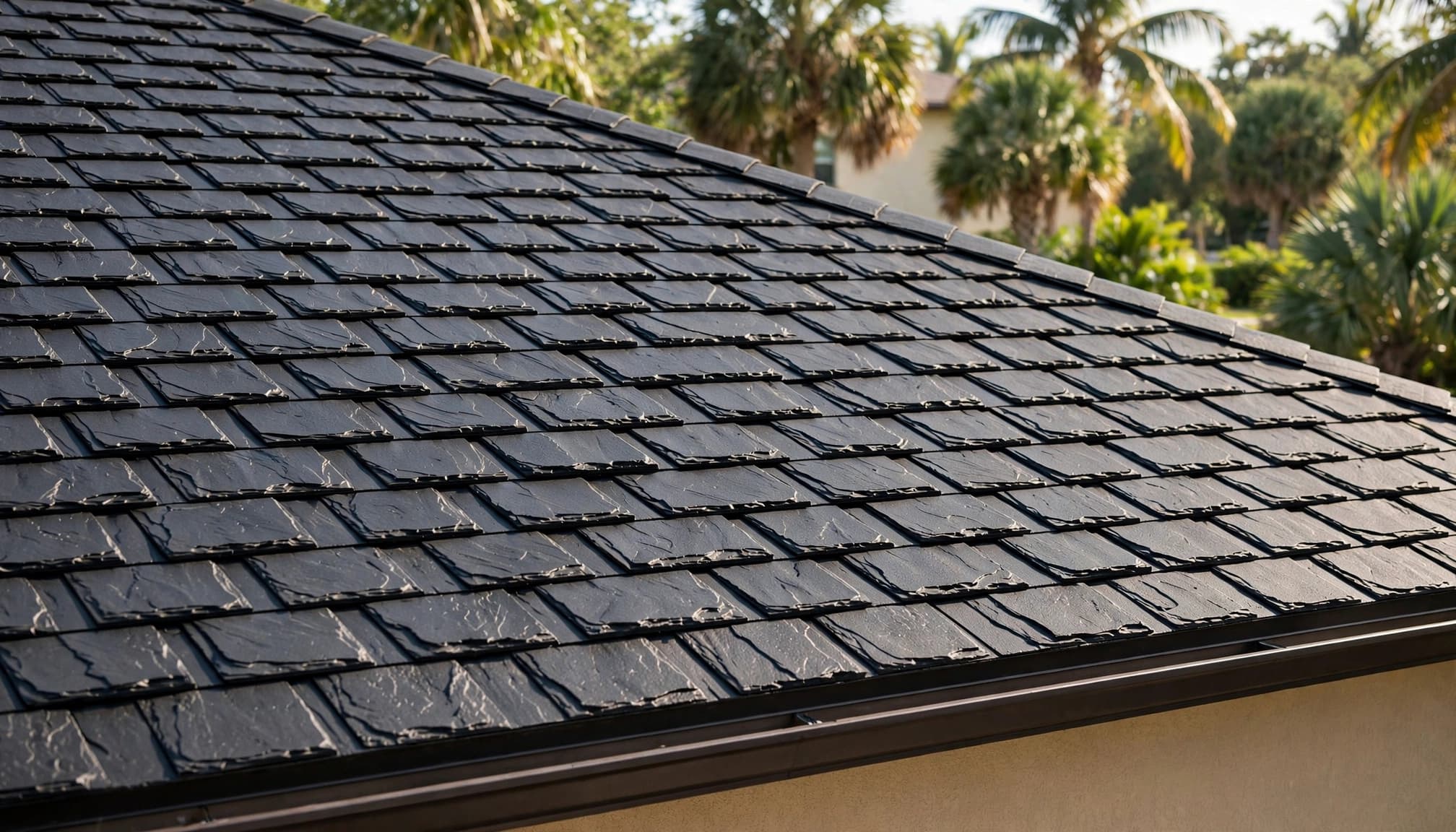
Product dimensions also affect the finished appearance. An ICC-ES report for Brava Old World Slate lists tiles measuring 22 by 12 inches, with a 10-inch installed exposure. Exposure describes the portion left visible after overlapping courses.
Those details influence layout and material quantities. However, they shouldn't become installation instructions for another product, and the contractor must confirm the applicable current documentation.
Ask to see physical samples outside. Texture, color variation, and edge thickness can look different under Southwest Florida's strong sunlight than in a brochure.
How Heat, Humidity, and Heavy Rain Affect the Choice
Fort Myers weather places different demands on different parts of a roof. A suitable covering still needs compatible components and careful water-management details.
Heat and humidity require more than a color choice
Sun exposure and repeated heating make the manufacturer's spacing, fastening, and thermal-movement instructions important. Ask how the selected product addresses ultraviolet exposure and whether its warranty includes color changes.
A light-looking roof isn't automatically an energy-efficient roof. Compare published solar-reflectance information when available, together with the home's insulation and attic design.
Meanwhile, humidity makes moisture control important. Ventilation must suit the roof assembly, and existing attic condensation deserves investigation before replacement. Changing the outer covering won't resolve a disconnected bathroom exhaust duct or another indoor moisture source.
Heavy rain tests flashing and drainage
Valleys, roof-to-wall intersections, vents, and other penetrations need close attention because wind-driven rain can enter small openings. Flashing should direct water outward through a coordinated assembly.
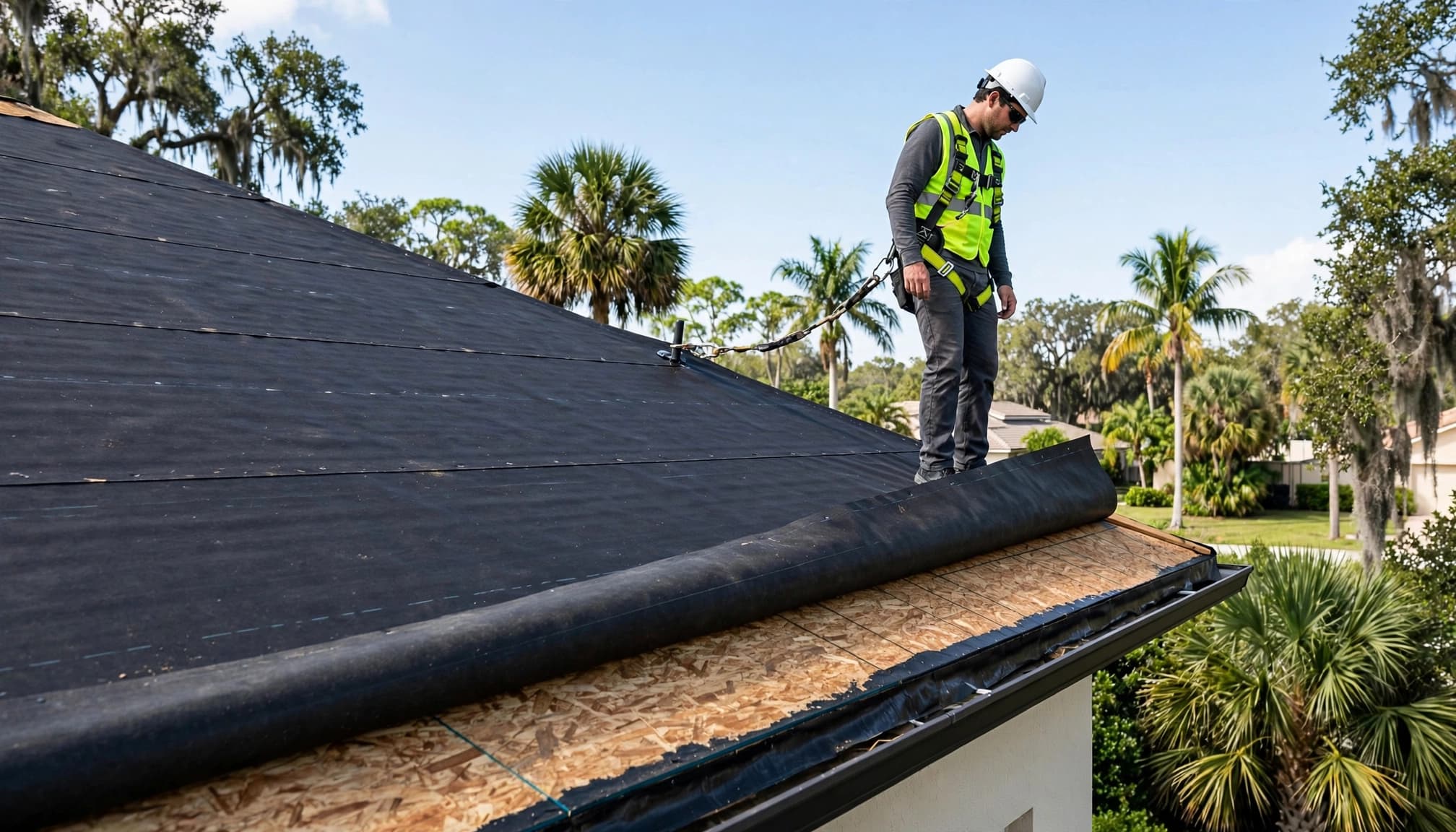
Underlayment provides protection beneath the covering, but its selection and attachment must match the approved system. Confirm whether a secondary water barrier is required or appropriate for the permitted scope.
Also examine drainage around additions and lanais. A roof replacement should address troublesome intersections rather than conceal them beneath attractive new material.
Hurricane Winds Require Project-Specific Design
A statement such as "rated for hurricanes" doesn't tell you whether a roof system meets your home's requirements. Fort Myers properties need wind design that accounts for the actual building and site.
Design wind speed, exposure category, roof height, opening protection, and roof shape can affect the required assembly. A home beside open water may have different exposure conditions than a sheltered inland property.
Wind also produces different uplift pressures across a roof. Edges and corners can require attachment details that differ from the main roof area.
For synthetic slate roofing, ask the contractor to connect the product documentation to the project's required design pressures. The deck and its connection to the framing also need review.
A manufacturer's wind-warranty speed and a project's code-required wind design aren't interchangeable measures.
Even a correctly specified roof has limits. No covering should be described as hurricane-proof, and product ratings don't guarantee protection against every combination of wind, debris, and water intrusion.
Product Approvals, Installation, and Local Code
Verify the exact approval and assembly
Florida Product Approval records and Miami-Dade Notices of Acceptance describe specific products and installation conditions. Check whether the applicable document is current, expired, or superseded.
Then review the assembly itself. Deck requirements, minimum slope, exposure, fastener type, and attachment patterns can determine whether the proposed system works.
Fire classifications and impact ratings answer different questions from wind-uplift approvals. Ask for documentation covering the performance measures relevant to your project.
Planning roof installation in Fort Myers should include these checks before ordering material. Approval of one configuration doesn't authorize every possible installation using the same covering.
Confirm jurisdiction and inspection requirements
Lee County's roof permitting guide, updated August 14, 2026, identifies the Florida Building Code, 8th Edition (2023). It also calls for Florida Product Approval numbers for covered roofing products.
First determine whether your property falls under the City of Fort Myers or Lee County permitting authority. Confirm the applicable code edition, permit scope, and submission requirements with that office.
Lee County's inspection documentation requires the roof dry-in inspection to pass before the completed-roof inspection. Construction scheduling should account for that sequence.
An insurance inspection form isn't a substitute for structural specifications. Deck thickness, span rating, panel support, and fastening must follow the applicable plans and requirements.
Comparing Synthetic Slate With Common Alternatives
Material names offer a starting point, but exact products and assemblies make the comparison useful.
| Roof covering | Defining characteristic | What to evaluate |
|---|---|---|
| Synthetic slate | Manufactured slate-style pieces | Current approvals, installed load, fastening, and warranty |
| Natural slate | Quarried stone roofing | Structural capacity, slate quality, and installer experience |
| Asphalt shingles | Overlapping, granule-surfaced shingles | Product ratings, accessory components, and local bids |
| Metal roofing | Metal panels or formed profiles | Attachment, coating, corrosion exposure, and detailing |
| Clay or concrete tile | Individual molded or fired tiles | Structural support, attachment, and underlayment |
The practical choice is the system that satisfies your design goals and project requirements at an acceptable installed cost.
Natural slate offers authentic stone texture, while synthetic products reproduce that appearance with manufactured pieces. Compare actual installed loads rather than assuming either covering suits the existing framing.
Asphalt shingles are a common local option. Metal offers a different architectural look, while clay and concrete tile are familiar choices for many Southwest Florida homes.
However, no material category automatically wins on storm performance or service life. Each comparison needs the selected product, approved assembly, installation quality, and maintenance expectations.
Where Synthetic Slate Fits in Fort Myers
Synthetic slate roofing is worth evaluating when the slate appearance is a priority and the product can satisfy the home's technical requirements.
New construction and major remodeling
A new build allows the designer to coordinate roof pitch, framing, drainage, and covering early. That makes it easier to evaluate a slate-style system before structural and architectural decisions become fixed.
For a whole-home remodel, review how the roof relates to new additions and existing roof planes. Different slopes or intersection details may require different solutions.
Also check neighborhood or homeowners association restrictions before purchasing materials. An acceptable color doesn't necessarily mean an acceptable profile, and an architectural approval doesn't replace building-code review.
Replacement on an existing home
Replacement begins with the roof's condition. An on-site assessment should examine framing, sheathing, evidence of leakage, flashing, and the feasibility of the proposed assembly.
Professional roof inspections in Fort Myers can help identify issues that affect suitability and scope. Concealed deterioration may require further evaluation after tear-off.
A synthetic covering shouldn't become a shortcut around damaged decking or inadequate attachment. If substantial structural repairs are necessary, include them in the decision before comparing finish materials.
Finally, ask whether the installer has experience with the exact product and can obtain matching replacement pieces later.
Cost, Warranty, and Expected Service Life
A useful estimate separates the covering from the rest of the work. Tear-off, disposal, deck repairs, underlayment, flashing, access, permits, and required engineering can all affect the total.
Therefore, compare written proposals with equivalent scopes. A lower figure may exclude repairs or components that another contractor includes.
Avoid assigning synthetic slate a universal installed price or lifespan. Product formulation, installation, exposure, and maintenance all matter, and local labor costs vary.
Warranty length also needs careful reading. Brava's Florida installation supplement describes a 50-year limited warranty for wind damage determined to result from a manufacturing defect, with conditions tied to installation.
That doesn't promise an untouched roof for 50 years. Review exclusions, labor coverage, transfer provisions, and the process for making a claim.
Also ask about repair access and maintenance. Walking procedures, cleaning methods, and replacement instructions should follow the selected manufacturer's guidance.
Key Takeaways Before Choosing a Product
- Choose a specific product and approved assembly, not a general promise about synthetic slate.
- Evaluate heat, moisture, rain detailing, and wind exposure alongside appearance.
- Confirm current local permit requirements and the product approval's status.
- Compare complete installation scopes, including necessary deck and flashing work.
- Treat warranty terms separately from expected service life.
An on-site assessment turns those questions into a recommendation based on your home's actual conditions.
Frequently Asked Questions
Can synthetic slate go on a low-slope roof?
The product's approved minimum slope controls the answer. A covering approved for one pitch may be unsuitable for a lower roof plane.
Ask the contractor to check each section, including additions and lanais. Where a roof falls outside the product's approved limits, the design needs an appropriate alternative assembly.
Will synthetic slate reduce my insurance premium?
Don't assume a material change automatically produces a discount. Ask your insurer what documentation it requires and which verified features affect eligibility.
Wind-mitigation documentation may involve roof-deck attachment, roof-to-wall connections, opening protection, and water-barrier details. Those features are distinct from the roof covering's appearance, and the insurer must confirm any pricing effect.
Choose the Roof System That Fits Your Home
Synthetic slate can bring a distinctive appearance to a Fort Myers home when the product, structure, and installation requirements align. Its suitability comes from project-specific evaluation , rather than broad claims about storms or longevity.
Before committing, have a licensed roofing professional assess the roof and explain the applicable approvals, repairs, and permit requirements. The right decision accounts for the entire assembly beneath the slate-style finish.