What Does a Gunite Pool Cost to Run in Cape Coral?
Explore Our Services
Contact Us Today!
(239) 322-9295
A typical 15,000-gallon gunite pool in Cape Coral can cost about $165 to $241 per month for professional cleaning, routine chemicals, pump electricity, and replacement water, without heating. That works out to approximately $1,980 to $2,892 annually, before repairs and equipment replacement.
These ongoing gunite pool costs depend on your service package, equipment settings, water use, and swimming habits. For a useful ownership budget, start with routine operation, then separate optional heating and occasional repair expenses.
Key Takeaways
- Budget roughly $165 to $241 monthly for an unheated pool with professional service under the assumptions below.
- Cleaning and chemicals account for most of this estimate, so avoid counting included chemicals twice.
- Heating needs a separate allowance because temperature settings, weather, covers, and swimming schedules change energy use.
- Equipment replacement and resurfacing belong in your long-term budget, outside routine monthly operation.
A Monthly and Annual Budget for Routine Operation
For a representative 15,000-gallon pool, the following budget combines published Cape Coral service prices with calculated electricity and water allowances.
| Expense | Monthly allowance | Annualized allowance |
|---|---|---|
| Professional cleaning and routine chemicals | $138 to $175 | $1,656 to $2,100 |
| Circulation-pump electricity | $14 to $32 | $168 to $384 |
| Replacement water | $13 to $34 | $156 to $408 |
| Routine operating total | $165 to $241 | $1,980 to $2,892 |
The takeaway is a working budget, rather than a measured citywide average. Actual bills can fall outside these ranges, especially with older equipment, heavy debris, or frequent heating.
This estimate assumes an established pool, a service package covering routine chemicals, and a variable-speed pump. It excludes heater energy, major algae recovery, equipment replacement, resurfacing, and unusual water loss.
Annual figures simply multiply the monthly allowances by 12. They aren't a prediction that every month will cost the same. Rainfall, cooler weather, visiting family, and changes in pump schedules can shift individual months.
Keeping those categories separate also makes competing maintenance proposals easier to compare.
What Electricity and Replacement Water Cost
Pump electricity depends on power draw and runtime
Cape Coral homeowners generally receive electricity through LCEC. Its residential electricity rates support a planning rate of approximately 11.8 to 13.3 cents per kilowatt-hour, including the displayed power-cost adjustment but before taxes.
A pump averaging 0.5 to 1.0 kilowatt over eight hours daily uses approximately 120 to 240 kilowatt-hours in a 30-day month. Under those assumptions, electricity costs about $14 to $32 monthly.
That calculation covers circulation only. A cleaner's booster pump, spa jets, or extended high-speed operation adds consumption.
Variable-speed equipment gives you more control, but settings still matter. The schedule must support filtration, sanitation, and any equipment with minimum-flow requirements. Running fewer hours without considering those needs can create water-quality problems.
Water costs depend on household usage tiers
Cape Coral's utility rates effective October 1, 2026 list water commodity charges of $5.44 per 1,000 gallons for the first 5,000 gallons. The next tier, covering 5,001 through 10,000 gallons, costs $8.14 per 1,000 gallons.
A replacement-water allowance of 2,400 to 4,200 gallons monthly therefore produces approximately $13 to $34 in water charges within those tiers. Household consumption determines where additional pool water falls.
This is an illustrative allowance for evaporation-related replacement, not a universal requirement. Rain can reduce top-offs, while wind, splash-out, and backwashing can increase them.
The city's $25.36 monthly water capacity charge belongs to the household account. It shouldn't be counted again as a pool-only expense.
Cleaning and Chemicals: What You're Paying For
Professional service is usually the largest routine expense
Provider-published prices give a useful starting point. Puddle Pools lists Cape Coral full-service cleaning and chemicals at $138 to $158 monthly. Meanwhile, Liquid Concepts' Cape Coral service pricing lists standard weekly service at $135 to $175 monthly.
Those are individual providers' advertised ranges, not a local average or our service prices. Pool size, condition, access, and chemical demand affect the final package.
Compare the actual scope. Routine water testing, cleaning, and chemical treatment are different expenses from specialty stain treatment, major algae recovery, or equipment repair. Filter disassembly and replacement materials may also sit outside routine service.
If routine chemicals are already included in your maintenance package, adding a separate monthly chemical allowance counts the same expense twice.
DIY care and salt systems change the work
Doing your own cleaning removes paid cleaning labor, but you still need testing supplies, sanitizer, balancing chemicals, and filter care. Because consumption varies, the professional-service line shouldn't be relabeled as a DIY chemical budget.
Liquid Concepts lists chemicals-only service at $75 to $110 monthly. That's a service package, not the retail cost of chemicals alone.
Saltwater pools also require ongoing care. Their cells generate chlorine, while owners still manage pH, water balance, cell cleaning, and eventual replacement.
For gunite, balanced chemistry protects the interior finish as well as the equipment. Our guide to gunite pool finish care explains why cleaning methods and chemical limits should match the selected surface.
How Optional Heating Changes the Budget
Match the heater to your swimming schedule
Heating sits outside the $165 to $241 routine budget because its operating pattern differs so much between households.
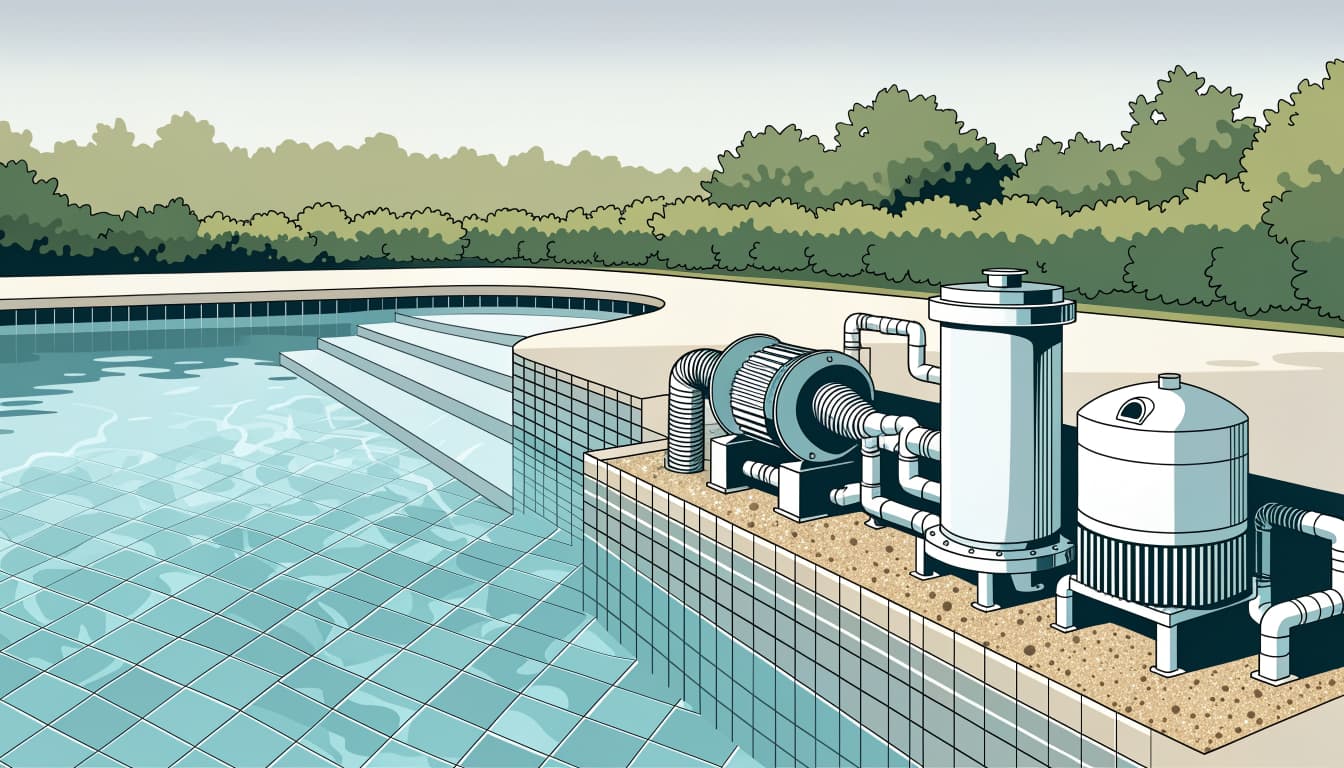
A pool heat pump draws warmth from surrounding air. Southwest Florida's warm conditions generally suit this equipment, although output falls as air temperatures drop. Heat pumps warm water gradually and fit regular swimming schedules.
Gas heaters warm water more quickly. That makes them useful for occasional swimming or a connected spa, where you may want a substantial temperature increase without maintaining it continuously.
The operating bill depends on the chosen equipment, fuel or electricity rate, pool volume, weather, and desired temperature. A pool kept warm throughout winter has a different energy requirement than one heated for occasional weekends.
Covers and temperature settings affect heat loss
A suitable pool cover reduces evaporation, which also reduces heat loss. This matters during breezy weather and cool nights, when an uncovered pool can lose warmth between swimming sessions.
Higher temperature settings increase the heating requirement. Therefore, your preferred swimming temperature belongs in the budget discussion alongside equipment efficiency.
Solar pool heating offers supplemental warmth with low operating costs, but sunshine, shade, roof area, and winter conditions limit output.
Automation can manage heating schedules and temperature settings. However, controls can't eliminate the energy needed to replace heat lost through the water's surface.
Why Gunite Pool Costs Vary Between Homes
Pool size affects several expenses at once. More water requires more treatment, while a larger exposed surface increases opportunities for evaporation and heat loss. Depth adds volume even when two pools have similar footprints.
Usage matters, too. Frequent swimmers introduce sunscreen, sweat, and other contaminants. Meanwhile, an open pool near landscaping may collect more leaves and windblown dirt than a screened pool.
Equipment choices create another difference. A pressure-side cleaner that needs a booster pump adds electrical consumption and another component to maintain. Our comparison of robotic and pressure-side cleaners covers those ownership tradeoffs.
Filters also carry different recurring tasks. Cartridge filters need element cleaning and eventual replacement. Sand and DE systems involve their own media and service requirements, and backwashing uses water. Our guide to pool filter operating costs compares those considerations.
Finally, unnecessary high-speed pumping and neglected filters can increase operating demands. Effective cost control starts with a coordinated system that receives routine care, rather than simply shortening every equipment schedule.
Frequently Asked Questions About Pool Ownership Costs
Does a seasonal home still need year-round pool care?
Yes. An unused pool still needs circulation, sanitation, testing, and cleaning. Sunlight, rain, and debris continue to affect the water even when nobody swims.
Lower swimmer demand may change chemical consumption, but it doesn't remove the need for maintenance. Neglect can lead to algae, staining, and cleanup expenses.
For seasonal ownership, keep routine service in the annual budget. Heating can follow your occupancy schedule, but water care needs to continue during absences.
Are repairs and resurfacing included in the monthly estimate?
No. The routine estimate covers service, pump electricity, and replacement water. Pump repairs, heater problems, salt-cell replacement, and interior resurfacing are separate ownership expenses.
For long-term planning, Southwest Florida gunite resurfacing projects can fall around $5,000 to $15,000, depending on finish and preparation. Shell repairs, tile work, and broader renovation can change that amount.
A separate repair reserve keeps these irregular expenses visible without presenting them as recurring utility charges.
Will an automatic refill system control water costs?
An automatic refill system maintains the water level, but it doesn't reduce evaporation or repair a leak. Because it adds water without a hose-filling routine, unusual consumption may become less obvious.
Unexpected increases in water use deserve attention. A pool professional can assess persistent losses, especially when they continue beyond normal weather-related changes.
The useful ownership habit is to track water consumption alongside equipment condition, rather than assuming a stable waterline means stable water use.
Build Your Budget Around How You'll Use the Pool
For an established Cape Coral gunite pool, $165 to $241 monthly is a useful starting allowance under the stated assumptions. Keep optional heating and irregular repairs outside that routine figure.
The most useful budget matches your pool's equipment, maintenance package, and swimming schedule. It also counts included chemicals only once.
When we plan pool construction or renovations, we can coordinate those choices around how you want to use your backyard.