Why Kitchen Drawers Rub After New Flooring Goes In
Explore Our Services
Contact Us Today!
(239) 322-9295
New flooring can make kitchen drawers rub by reducing clearance beneath low drawer fronts or exposing cabinet alignment problems. However, most standard drawers sit well above the floor, so a rubbing slide usually points to a disturbed drawer or cabinet rather than direct floor contact.
If the trouble started immediately after installation, stop forcing the drawer and identify the contact point first. That distinction separates a small alignment issue from flooring or cabinetry that needs correction.
Key Takeaways
- Added flooring thickness can interfere with unusually low drawers, toe-kick drawers, or nearby trim, but it shouldn't directly affect elevated drawer slides.
- Rubbing inside the cabinet usually calls for an alignment inspection, especially if drawers were removed during construction.
- Several affected drawers, changing cabinet gaps, or raised flooring deserve professional attention before anyone alters finished surfaces.
How New Flooring Changes Drawer Clearance
The important measurement is the difference between the old finished surface and the new one. Flooring, mortar, underlayment, and leveling materials can all contribute to that change.
Low drawer fronts can lose clearance
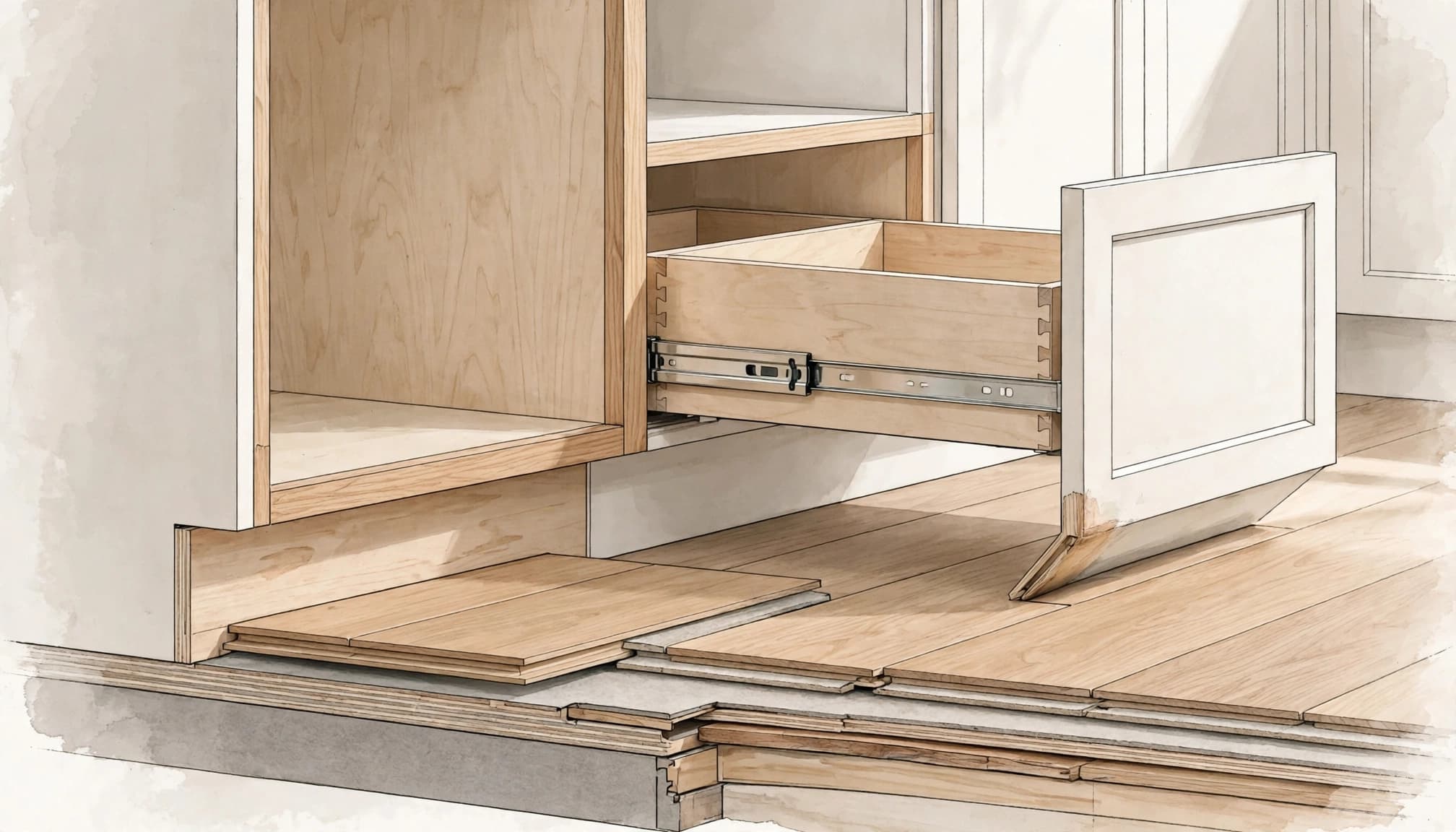
A toe-kick drawer occupies the recessed area near the floor beneath a base cabinet. Its front may have little space underneath, so a higher floor can obstruct its travel.
An oversized lower drawer front can have a similar problem. Nearby shoe molding or replacement toe-kick trim may also project into its path.
However, ordinary drawers above a conventional toe kick shouldn't suddenly touch the floor. If an upper drawer starts scraping, the new floor height alone doesn't explain it.
Slides respond to cabinet alignment
Drawer slides attach to the cabinet and drawer, not to the exposed kitchen floor. Installing flooring around an undisturbed cabinet doesn't automatically change their position.
However, the installation may involve removing drawers, replacing trim, or moving cabinetry. If the cabinet loses proper support or twists during that work, the slides can stop running parallel.
The result may feel like a flooring problem because it appeared afterward. The actual contact can still be inside the cabinet.
Find Exactly Where the Drawer Rubs
Empty the affected drawer before inspecting it. This reduces its weight and helps distinguish a clearance problem from a drawer that sags under its contents.
Move it slowly only as far as it travels freely. Stop at resistance rather than pushing through it.
Inspect the front and surrounding surfaces
Look for fresh scuffs along the drawer front's bottom edge, neighboring fronts, cabinet frame, trim, and floor. A matching mark on two surfaces helps locate the obstruction.
Also examine the narrow spaces around the drawer front, often called reveals. One tight corner with a wider opposite gap suggests alignment trouble.
If the front contacts the floor, note whether it touches immediately or only farther into its travel. Contact farther out may indicate sagging rather than a uniformly inadequate gap.
Look inside the cabinet opening
If the front clears everything, look along the drawer sides and visible hardware. Construction debris, a displaced drawer, or hardware projecting into the travel path can create resistance.
A drawer removed during flooring work may also have been returned to the wrong opening or seated incorrectly. Similar-looking drawers aren't always interchangeable.
Avoid reaching into concealed mechanisms or releasing unfamiliar hardware while the drawer remains loaded.
Use the Rubbing Pattern to Narrow the Cause
The location and number of affected drawers provide useful clues. Compare the problem drawer with neighboring ones without repeatedly dragging it across the damaged area.
One affected drawer points toward a local issue
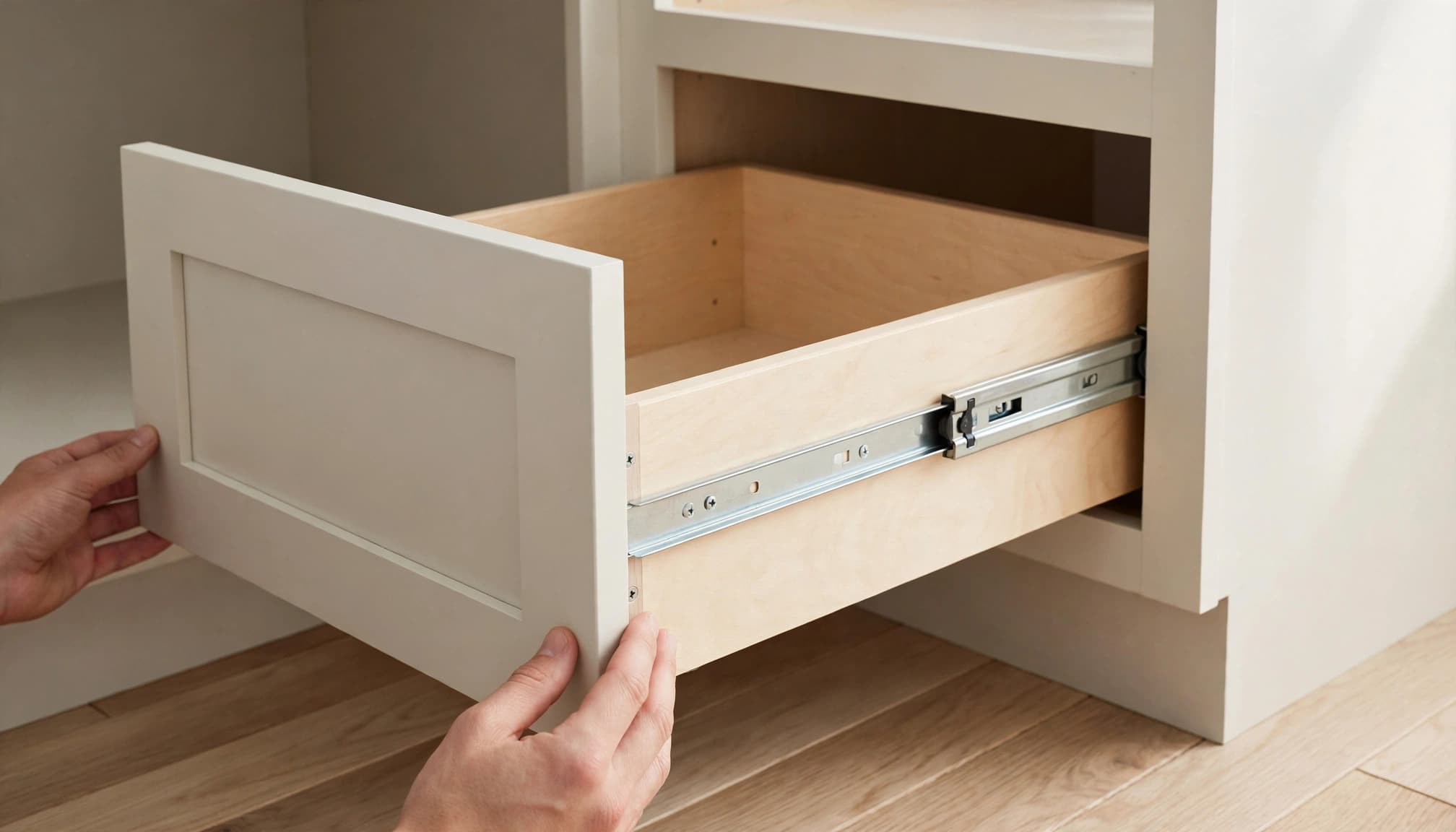
When one drawer rubs but adjacent drawers work normally, focus on that drawer's fit, front alignment, and hardware.
If it operated correctly before removal, its position after reinstallation deserves attention. Meanwhile, a drawer that moves freely when empty but catches when loaded may have a support or hardware problem.
New flooring can reveal an existing weakness without being its direct cause. Don't assume every problem requires changing the floor.
Several affected drawers suggest a wider problem
If multiple drawers in one cabinet run develop uneven gaps, the cabinet boxes may have shifted or lost alignment. Nearby doors that also begin rubbing strengthen that possibility.
In contrast, several low drawers touching a newly raised floor suggest insufficient clearance at the cabinet base.
Look at the flooring too. A raised area near the cabinets is different from an evenly higher finished surface.
A higher floor beside a cabinet doesn't, by itself, move the slides inside it. Widespread slide binding calls for a cabinet-alignment inspection.
When a Simple Adjustment May Be Enough
A limited adjustment may be appropriate when the cabinet remains stable, the drawer box is sound, and the problem affects one front or slide.
For example, some drawer systems include adjustments for front alignment. Others require a different approach. The available adjustment depends on the installed hardware; there isn't one universal screw that fixes every rubbing drawer.
A cabinet installer can distinguish a front that needs alignment from a drawer box that no longer travels correctly. That matters because moving the front won't necessarily correct internal binding.
Loose construction debris may explain a minor obstruction. However, rubbing that continues after the visible travel path is clear needs further evaluation.
Avoid sanding or trimming first. Removing finished material can expose vulnerable edges and leave uneven gaps. It can also disguise a cabinet problem that remains unresolved.
Likewise, forcing the drawer can damage its runners, front, or the new floor. Stop using it if normal movement requires extra pressure.
When Flooring or Cabinets Need Professional Correction
Professional correction becomes more appropriate when several drawers bind, the cabinet appears twisted, or a low drawer has lost its usable clearance.
Cabinet movement deserves particular care because base cabinets support countertops and may connect to plumbing or appliances. Raising or repositioning them can affect more than the drawer opening.
The flooring needs attention when its surface rises unevenly near the cabinetry, separates, or presses tightly against fixed objects. A small drawer adjustment won't resolve an underlying installation problem.
Floating flooring requires space to expand and contract. Fixed cabinets or tightly fitted trim can restrict that movement, allowing the floor to peak or distort later.
Therefore, trim should conceal the required perimeter space without clamping the floor. Filling that space with rigid material can defeat its purpose.
For Southwest Florida homes with concrete slabs, slab conditions also matter. Moisture can move through concrete even when the surface looks dry. Uneven areas or unsuitable moisture conditions need attention as part of the flooring installation.
The appropriate professional depends on the finding: a cabinet installer for alignment, a flooring installer for floor movement, or a remodeling contractor when both systems are involved. Keep the flooring and cabinet concerns in the same conversation so one correction doesn't create another conflict.
Prevent Rubbing by Planning the Finished Floor Height
Clearance planning should happen before new materials arrive. The finished-floor height includes the complete installation, not simply the thickness of a tile or plank.
Slab or subfloor preparation comes first. High spots, cracks, old adhesive, and uneven areas can affect the finished surface, while the flooring product sets its own preparation requirements.
Next, coordinate the cabinet layout with the flooring installation method. Permanently bonded materials, including tile and approved hardwood installations, can often extend beneath cabinets.
Floating floors generally belong around fixed cabinetry so their movement space remains open. Luxury vinyl alone doesn't identify the correct sequence because products may be floating or adhered.
Our guide to flooring and cabinet installation order covers those differences and their effect on kitchen planning.
Include low drawer fronts, toe kicks, appliance bays, and transitions in that plan. A higher floor can reduce dishwasher removal clearance beneath the countertop even when nearby drawers work perfectly.
Finally, put the intended finished-floor height and installation sequence into the project scope. Cabinet and flooring trades need the same reference height, especially when new flooring meets retained cabinetry. Before the project closes, operate every drawer and appliance door through its full usable travel without forcing anything.
Frequently Asked Questions
Can new flooring make kitchen drawer slides rub?
It can contribute indirectly if cabinetry shifts or a drawer isn't returned correctly after removal. However, flooring installed around stable cabinets doesn't directly raise or lower the slides inside them. The rubbing location determines which explanation fits.
Why does only the bottom kitchen drawer rub?
A low drawer may have lost clearance above the finished floor or nearby trim. However, a bottom drawer that rubs inside the opening can still have an alignment or hardware issue. Its position alone doesn't prove floor contact.
Will the drawer loosen up with use?
Repeated rubbing can wear away the finish or damage hardware rather than solve the underlying problem. A floating floor that has become restricted also needs correction instead of continued pressure. Stop forcing the drawer and address the contact point.
Should the drawer front be cut shorter?
Trimming shouldn't be the first response. First establish whether the obstruction comes from floor height, trim placement, drawer alignment, or cabinet movement. Cutting the front before identifying the cause can leave permanent damage without restoring smooth operation.
Restore Clearance Without Creating More Damage
Kitchen drawers rubbing after flooring installation need a contact-point diagnosis before any adjustment. Direct floor interference and internal slide binding require different solutions.
A local alignment problem may need a limited correction. Widespread binding or raised flooring calls for a broader review of the cabinets and floor.
Protect both finished surfaces by stopping at resistance and correcting the cause before returning the drawer to everyday use.