


If you're planning a custom home in Southwest Florida, the first big cost question often isn't the roof or the windows. It's architectural design fees . The range can feel wide, and the proposals can look like they're written in a different language.
Here's the practical truth in 2026: your fee depends less on a magic "percent" and more on what you're asking the architect to deliver, plus what your lot demands. In SWFL, that usually means wind, water, elevation, and permitting details that can't be skipped.
Below is a homeowner-friendly guide to what you're paying for, how fee models work, and how to avoid scope gaps that cause surprise invoices.
What you're really buying when you pay architectural design fees in SWFL
Think of design like a movie production. The pretty pictures are the trailer. The real work is the script, the shot list, and making sure every scene can actually be filmed. In homebuilding, that "can we build this?" work is what protects your budget and schedule.
Most custom-home architectural services fall into a few phases:
- Concept and schematic design : Layout options, massing, basic elevations, and early budget reality checks.
- Design development : Key dimensions get locked, major materials are chosen, and systems start to coordinate (roof lines, window sizes, ceiling heights).
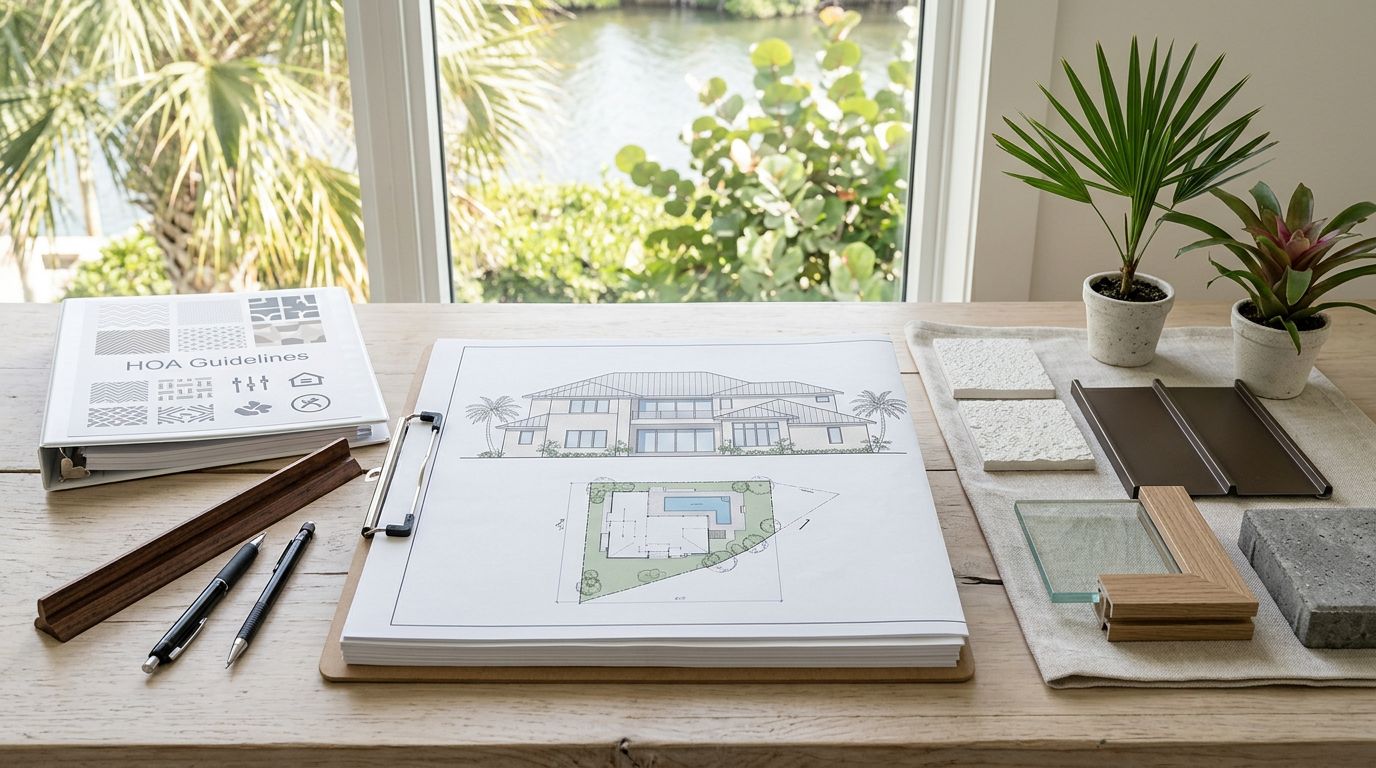
- Construction documents : The permit-ready plan set. This is where details, notes, schedules, and sections live.
- Permit coordination : Responding to plan review comments, revising sheets, and re-submitting.
- Construction administration (CA) : Site visits, answering RFIs, reviewing shop drawings, and clarifying details during the build.
In Southwest Florida, these phases often expand because the site asks more questions. A coastal or canal lot can drive extra coordination around elevation targets, drainage, and setbacks. If you're building waterfront in Cape Coral, it's smart to understand how design can be constrained by seawalls and buildable area early, not after the first draft. This overview of building on a Cape Coral canal lot explains why lot rules can force redesigns.
Code is another reason SWFL design isn't "one size fits all." Florida's Building Code updates on a cycle, and high-wind and water-resistance details can add real drafting and engineering time. Flood zone rules also matter. Many owners start with FEMA flood maps, then confirm elevation requirements with their design team and local jurisdiction.
The biggest fee surprise usually isn't the rate, it's the scope. If "permit set" and "construction support" aren't defined, you can pay twice for the same progress.
2026 fee models for custom homes, plus what's usually included
Design fees are commonly quoted three ways: percentage, fixed fee, or hourly. Some firms also offer "plan-only" packages that stop at permitting, with CA as an add-on.
Before looking at numbers, ask one simple question: Will the architect stay involved once construction starts? In SWFL, that decision matters because field conditions and product substitutions happen, even with good planning.
Here's a side-by-side look at the main fee models.
| Fee model | How it's priced | Best for | Watch-outs |
|---|---|---|---|
| Percentage of construction cost | Often a set percent applied to the cost of the work | Complex custom homes where scope may evolve | Final fee can rise if construction cost rises, clarify what "cost" includes |
| Fixed fee (lump sum) | One price tied to a defined scope and deliverables | Owners who want cost certainty | Changes can trigger add-services fees, define revision limits |
| Hourly (time and materials) | Hourly rates plus billed time | Small scopes, renovations, early feasibility | Can drift without a not-to-exceed cap and clear task list |
| Hybrid (fixed + hourly) | Fixed for plan set, hourly for CA or revisions | Many SWFL customs | Make sure the handoff points are written |
| Plan-only package | Lower price for permit drawings only | Investors or owners with simple builds | You may pay more later for field support and changes |
So what do architectural design fees cost in Southwest Florida in 2026?
For custom homes, many owners see design costs land in a broad band that reflects complexity, not just size. Some projects are closer to a "permit drawings" purchase, while others are full-service with strong construction support.
As a practical starting point in 2026, many SWFL custom-home owners report tens of thousands of dollars for design, and higher when the home is large, highly detailed, coastal, elevated, or requires extensive coordination. National AIA consumer guidance discusses multiple pricing structures and why comparing proposals is about scope, not just price. Florida's own public fee guideline tools (used for certain state work) also show how scope and complexity change pricing assumptions.
Retainers, reimbursables, and billing schedules (the fine print that changes the total)
Most firms collect a retainer to start, then bill monthly or by milestone (concept, 50% CDs, permit submission, permit approval, CA). Ask whether the retainer is credited to the final fee.
Also ask what counts as reimbursable expenses . Common reimbursables include printing, shipping, travel for site visits, paid plan runs for HOAs, and sometimes specialty consultant coordination. None of these are "bad," but they should be visible.
How to keep design costs predictable (without dumbing down your home)
The easiest way to blow up design fees is to treat drawings like a rough draft until the permit is issued. Every late change ripples. Move a window, and you may touch structural notes, opening schedules, energy calcs, elevations, and exterior details.
You'll get better control by tightening decisions early and setting rules for changes. That's also where your builder relationship matters. If you're working with a cost-plus home builder , you can often align design decisions with real-time pricing feedback, so your plan reflects what you actually want to spend. For a clear explanation of how open-book costing works, see cost-plus home building in Southwest Florida. When the whole team is committed to transparent pricing , you can connect design choices to line items before they become change orders.
A homeowner checklist, questions to ask an architect before you sign
Use these questions to expose scope gaps early:
- What's included in "permit-ready plans"? Ask for a deliverables list, not a label.
- Are engineering disciplines included? Clarify structural, truss engineering coordination, and any MEP involvement.
- How many revision rounds are included per phase? Put a number on it.
- Will you handle permit comment responses? Confirm how many resubmittals are included.
- Do you offer construction administration? If yes, how many site visits and what triggers extra time?
- How do you price change orders to your scope? Get the hourly rate or add-services menu in writing.
- What do you need from me, and by when? Selections delays often become billable redesign time.
- How do you coordinate with the builder and trades? Ask how RFIs and clarifications are handled.
- What's excluded? Examples: landscape plans, interior design, lighting design, pool design, seawall work, or HOA packages.
- What's the schedule, and what can break it? Long-lead choices (windows, doors) affect detailing.
Change orders and scope gaps, how they show up in real life
A design change order isn't always a mistake. Sometimes it's the right call. The problem is when a "small tweak" quietly turns into redraw time across multiple sheets.
To avoid that, ask your architect to define:
- What counts as a change (layout moves, exterior redesign, structural shifts).
- How changes are approved (email approval is fine if the contract allows it).
- How fees are billed (hourly, fixed add-on, or not-to-exceed).
If you're still deciding between building custom versus buying a spec home, your design budget should be part of that choice. This guide on custom home vs. spec home in Southwest Florida explains why custom gives you control, but asks more planning discipline.
Conclusion
In 2026, architectural design fees in Southwest Florida depend on scope, site demands, and how involved your architect stays during construction. Clear deliverables, defined revision limits, and written change rules keep costs predictable. Pair that with a team that values transparent pricing , and you'll make decisions with fewer surprises.
Disclaimer: Fee ranges vary by home size, complexity, and jurisdiction. This article is general information, not legal or contract advice. Review your agreement terms with a qualified professional before signing.