Fort Myers Remodel Contingency: How Much to Set Aside
Explore Our Services
Contact Us Today!
(239) 322-9295
For a Fort Myers whole-home remodel, reserve 10% to 20% of the construction budget for unforeseen work. A well-defined project may need 10% to 15%, while an older home with unresolved conditions deserves 15% to 20%.
That reserve should remain separate from your planned spending, rather than becoming extra money for finishes. Start by separating what you already know the house needs from what demolition might uncover.
Key Takeaways
- Reserve 10% to 15% for a defined project with limited unknowns, or 15% to 20% for greater uncertainty.
- Include known repairs, permits, design work, and realistic material allowances in the planned budget.
- Use contingency for necessary, unforeseen work through documented change orders.
- Keep money available until concealed conditions, inspections, and remaining construction risks are resolved.
How Much Should Your Fort Myers Remodel Contingency Be?
We recommend choosing the percentage based on the home's condition and the completeness of the plans. These are planning recommendations, not a Lee County requirement.
Match the reserve to the risk
A 10% to 15% reserve fits a project with clear drawings, settled selections, accessible systems, and limited structural changes. It works best when the estimate already includes foreseeable repairs.
Move toward 15% to 20% when demolition will expose extensive concealed areas. Older plumbing, undocumented alterations, moisture history, and major layout changes increase uncertainty.
However, a larger percentage cannot fix an undefined scope. If structural damage or extensive water intrusion is already suspected, professional evaluation and a repair budget should come before construction.
Calculate it from a defined construction amount
Use the planned construction amount consistently. For a $150,000 construction budget, the reserve calculations are:
| Reserve percentage | Contingency amount | Construction plus reserve |
|---|---|---|
| 10% | $15,000 | $165,000 |
| 15% | $22,500 | $172,500 |
| 20% | $30,000 | $180,000 |
These figures show reserve math, not a whole-home remodeling price quote. Your complete spending plan may also include design, engineering, temporary housing, storage, and other costs outside the construction contract.
Also, identify any contingency already included in the contractor's proposal. An owner-held reserve and a contractor-controlled allowance may have different purposes and approval rules.
What Contingency Covers Versus the Planned Budget
A contingency fund pays for necessary work that wasn't reasonably defined when the project was priced. The planned budget covers the agreed work, including known repairs and required supporting tasks.
Put foreseeable expenses in the base budget
Demolition, disposal, routine permits, electrical changes, installation, and finish repairs belong in the estimate when the scope requires them. Leaving them out creates an incomplete budget.
Allowances also need enough detail. A $15,000 cabinet allowance means little unless it identifies whether panels, organizers, trim, hardware, delivery, and installation are included.
Choosing cabinets above that allowance is a selection overage, not a concealed-condition expense. Likewise, an addition needs its own planned budget. Our Fort Myers room addition cost guide addresses expansion costs separately.
Reserve contingency for genuine unknowns
Appropriate uses include concealed framing deterioration, damaged plumbing discovered behind walls, or unexpected floor preparation after existing finishes come out. Related engineering or permit revisions may also qualify when an unforeseen condition changes the approved work.
Keep optional upgrades separate. Premium appliances, decorative lighting, and expanded scope should have their own funding.
Spending contingency on upgrades before demolition ends leaves less protection precisely when concealed-condition risk is highest.
Why Older Fort Myers Homes Need More Flexibility
The amount of the house you open matters as much as its age. Replacing finishes exposes less than relocating kitchens, removing walls, and rebuilding bathrooms throughout the home.
Aging systems and previous alterations
Once walls open, a contractor may find deteriorated wiring, outdated plumbing, damaged framing, or earlier alterations that don't match the current plans. Removing flooring may also reveal uneven surfaces that require preparation before installation.
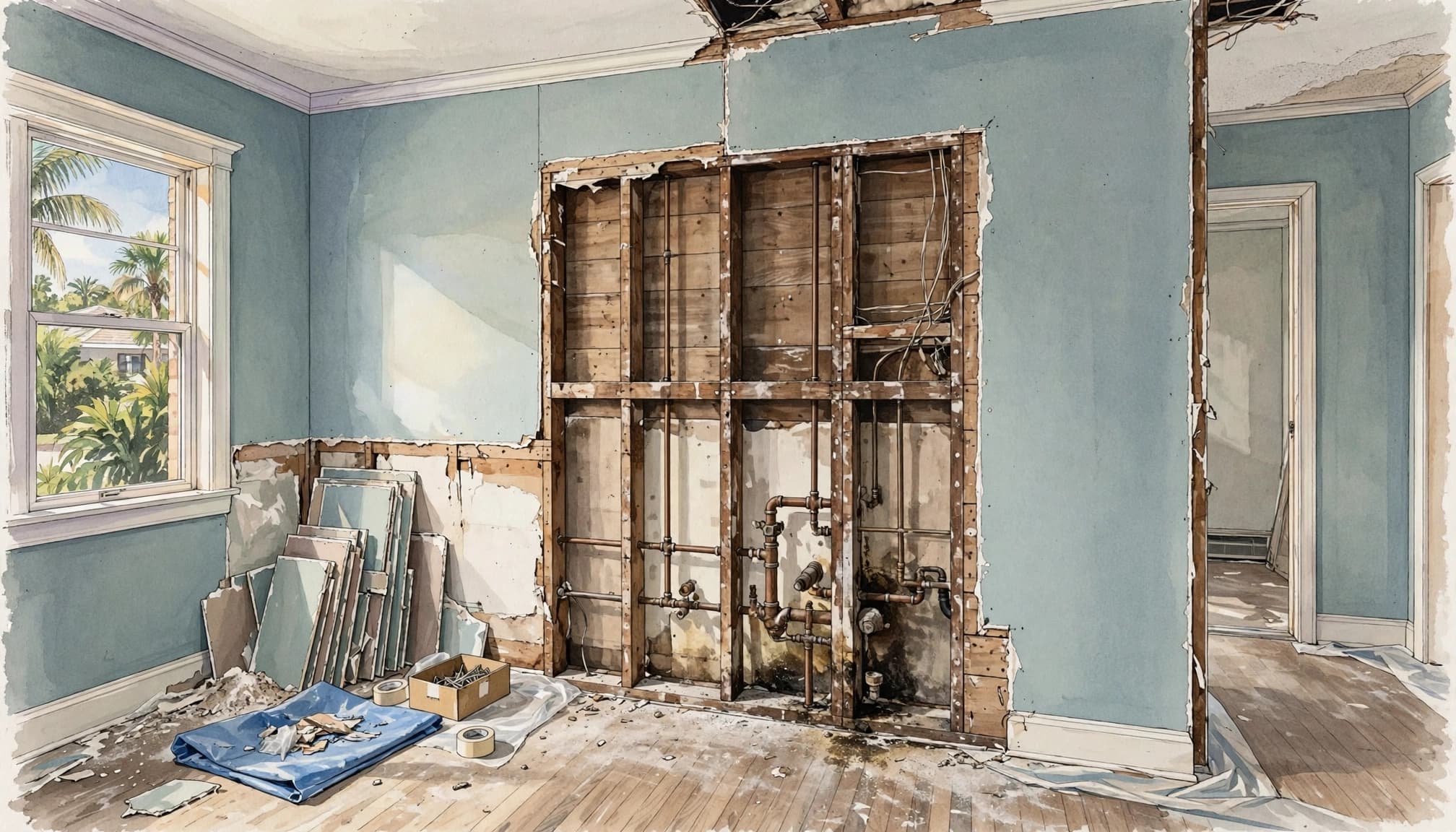
These discoveries can affect several trades at once. A plumbing repair, for example, may also require concrete, drywall, and finish restoration. Budgeting only for the pipe repair misses the full cost.
Storm history and moisture damage
In Southwest Florida, past roof leaks, wind-driven rain, flooding, and persistent humidity deserve attention before demolition. A painted-over stain doesn't establish that the underlying materials are sound.
Known leak repairs belong in the planned scope. Unexpected deterioration beyond the inspected area may justify contingency spending.
Suspected mold requires professional assessment and a planned response. Rebuilding should wait until the moisture source is corrected and affected areas are properly addressed and dry.
If roof work is already necessary, include it separately. Our Fort Myers roof replacement cost guide explains the scope items that affect that budget.
Permits and Flood Requirements Belong in Early Planning
A Fort Myers mailing address doesn't automatically place a property within the City of Fort Myers permitting system. Properties in unincorporated Lee County follow the county's process.
Jurisdiction affects applications, fees, reviews, and inspections. Lee County's updated building-permit fee schedule took effect April 15, 2026, but it doesn't establish one universal whole-home remodeling fee.
Routine permitting belongs in the original budget. Our Fort Myers kitchen permit requirements explain how electrical, plumbing, mechanical, and structural changes can trigger approvals.
Flood-related requirements can affect the project more substantially than an ordinary permit charge. The Lee County residential permit guide calls for an elevation certificate for projects in a FEMA Special Flood Hazard Area.
The guide also identifies certification requirements for certain work in regulatory floodways. These conditions deserve attention during design because they can change what the project requires.
A contingency fund shouldn't substitute for floodplain planning. When an unforeseen discovery changes the permitted scope, however, related design revisions may become a legitimate contingency expense.
Material and Labor Changes Need Contract Clarity
Material availability, delivery timing, and labor scheduling can change between an early estimate and installation. However, a price increase doesn't automatically become the homeowner's responsibility.

The contract should distinguish fixed prices, allowances, exclusions, and any price-adjustment provisions. It should also explain how substitutions and additional labor receive approval.
An allowance leaves part of the final price unsettled. Meanwhile, a fixed-price item has a different contractual basis. Don't assume both create the same exposure.
Complete selections early enough to coordinate dimensions, electrical requirements, ventilation, and installation. Changing an appliance after cabinetry is ordered can create several related expenses.
For roofing or concealed repairs, unit prices can make changes easier to evaluate. A proposal might identify decking replacement by a defined unit instead of leaving the entire repair amount open-ended.
Finally, separate warranty obligations and contractor-caused corrections from owner-funded changes. Contingency isn't automatic permission to transfer every overrun to you.
When to Use the Fund and How to Control It
Use contingency when work is necessary, wasn't reasonably included in the original scope, and falls within your responsibility under the contract. Document the decision before additional work proceeds whenever practical.
A consistent approval process keeps each expense tied to a specific condition:
- Record the discovery with photographs and a written explanation of why additional work is necessary.
- Obtain an itemized change order showing scope, price, applicable credits, and schedule effects.
- Approve the change in writing, then update the remaining contingency balance.
For urgent conditions involving active leaks or unsafe systems, establish emergency authorization limits in the contract before construction starts.
Keep a simple log showing the original reserve, approved changes, pending requests, and available balance. Pending costs matter because money awaiting approval is already potentially committed.
Review the reserve at major milestones, including demolition completion, rough-in inspections, and project closeout. As risks become clearer, update the remaining forecast rather than treating an untouched balance as spendable savings.
Also, keep planned living expenses separate. Predictable rental, storage, and moving costs shouldn't compete with repairs for the same reserve.
Frequently Asked Questions
Is a 20% contingency always enough?
No percentage guarantees that a remodel will stay within budget. Extensive structural damage, major moisture repairs, or a significant scope change can exceed an initial reserve.
For a home with serious unresolved concerns, investigation and a defined repair plan are more useful than choosing a larger percentage alone. Scale the project to fit the combined construction budget and reserve.
What happens if the contingency isn't used?
An owner-held contingency remains your money when no approved additional work requires it. It doesn't automatically become part of the contractor's payment.
If the contract includes a separate contractor-controlled contingency, its treatment depends on the written terms. Keep your owner-held reserve available through closeout, outstanding change orders, and final accounting before considering optional improvements.
Build the Reserve Before Construction Starts
A useful Fort Myers remodel contingency begins with a complete base budget and a reserve matched to the home's uncertainty. Keep known costs in the plan and protect uncommitted funds for necessary discoveries.
Before committing the full amount available to construction, leave room for the conditions hidden behind existing finishes. That separation gives you a clearer way to make decisions when the house reveals more work.