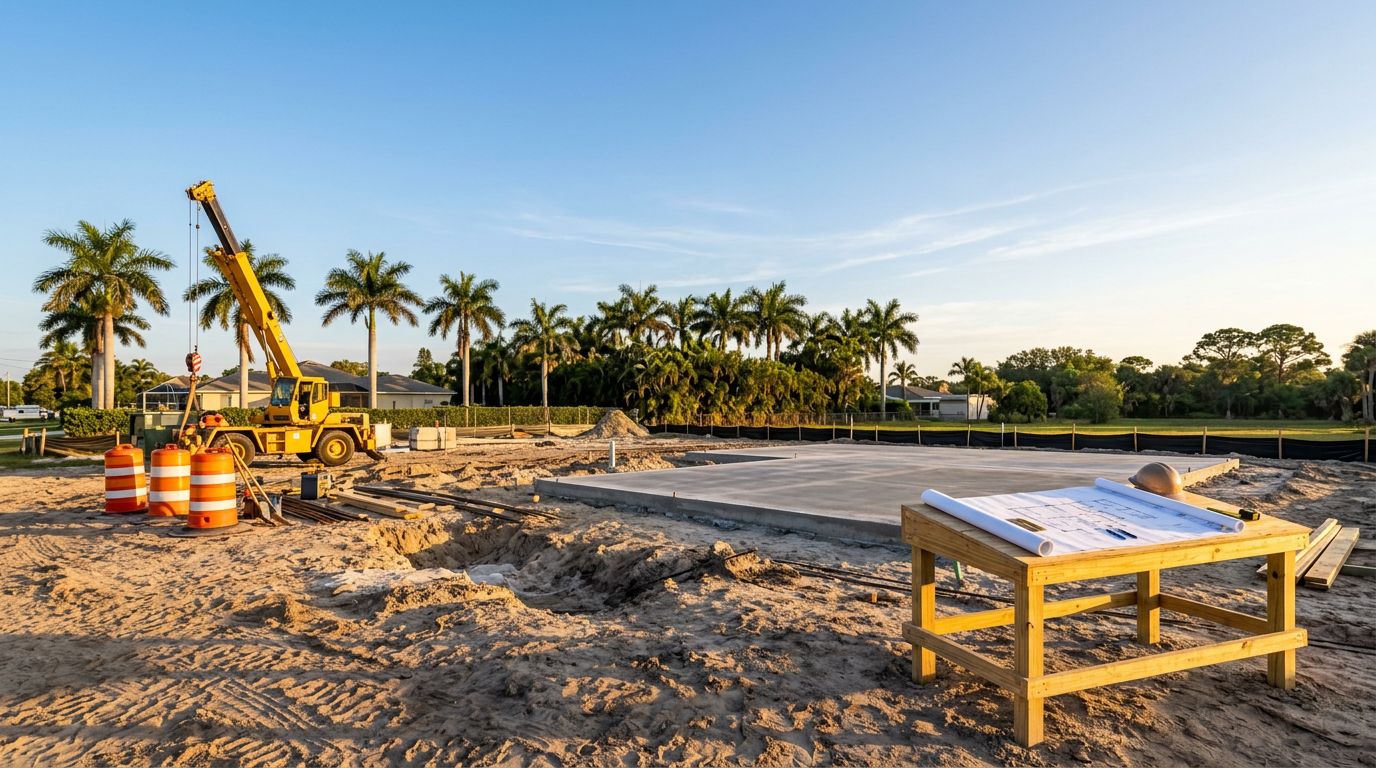



A lot can look ready for a house and still fail the permit review because one wall sits too close to a property line. That is why Lee County setback rules matter before you draw the first floor plan.
In 2026, the exact numbers still depend on zoning, lot shape, municipality, and special districts. So the safest move is to check the parcel first, then design around the real buildable area.
The basics are simple. The details are where projects get delayed. Start with how setbacks shape the lot itself.
How setbacks shape the buildable part of your lot
Setbacks are the required open spaces around a home. They control how close the structure can sit to the front, side, and rear property lines.
For permit review, the county or city wants the setback lines shown on the site plan. That means the plan needs more than a rough sketch. It has to show where the house, garage, porch, and other features sit in relation to the lot.
A plan can fit the square footage goal and still fail if a covered entry or garage edge crosses a yard line.
The key detail is measurement. Lee County commonly looks at the closest point of the house to the closest point of the property line . That sounds minor, but it can change the whole layout.
Corner lots, waterfront lots, and lots with unusual shapes can also change how the yard lines work. A standard rectangle is easier to design than a lot with two street frontages or a narrow back edge.
What changes the setback numbers in Lee County
The setback table is not the same for every parcel. A lot's zoning district usually sets the baseline, then the lot itself can adjust the answer.
| Factor | Why it matters | What to verify |
|---|---|---|
| Zoning district | Sets the base yard requirements | Current zoning map and code section |
| Lot width and depth | Some rules use formulas tied to lot size | Survey measurements |
| Corner or waterfront lot | May add street-side or water-side limits | Frontage, easements, and frontage type |
| Nonconforming lot | May qualify for different treatment | Parcel history and code status |
| Municipality | City rules can differ from county rules | Local permitting office |
| Special districts or deed restrictions | Can add more limits than the zoning code | Recorded documents and district rules |
The main takeaway is simple. You should never assume a nearby lot uses the same setbacks. Two homes on the same street can follow different rules if one is in city limits, one is in the county, or one sits on a lot with a special condition.
That is why a permit-ready design starts with the parcel, not the floor plan.
Common residential setback patterns to watch
Some residential lots in Lee County use formulas that look like this:
- Side setback : 10% of lot width, or 5 feet, whichever is greater
- Rear setback : 1/4 of lot depth, up to 20 feet maximum
- Street setback : follows the street setback section of the code
These are examples, not a universal rule for every site. The zoning district still controls the final number.
A simple example helps. If a lot is 100 feet wide, a 10% side setback would be 10 feet. On a different lot, the same formula could create a much larger yard requirement. That changes the home width, garage layout, and sometimes even the roof line.
Nonconforming lots need extra care. A lot can be legal, but still have special limits because it does not match current standards. Don't assume a small lot gets a free pass. In many cases, it needs a closer look.
The safest habit is to treat every yard line as fixed until the code says otherwise. That keeps you from spending money on a design that can't pass review.
Why surveys and site plans matter before you file
A current survey is one of the best tools you can have before design starts. It shows lot lines, easements, and site constraints that affect the buildable area.
If the survey is old, or if the lot changed after a split or consolidation, the plan can go stale fast. That is a problem because the permit reviewer wants the real site, not a guess.
Our site plan and survey requirements for construction guide explains why these documents matter before permits. A survey often becomes the base layer for the architect, engineer, and permit set.
A good survey also helps with flood and drainage questions. In Southwest Florida, those issues can affect where the home sits, how the driveway is placed, and whether extra drawings are needed. If the parcel has easements, you need to know about them early.
Do not rely on a county map alone. A permit set should match the survey, the code, and the lot as it exists today.
How city limits can change the answer
If your parcel sits inside city limits, Lee County guidance may not be the final word. City code can add its own setback rules, lot standards, and review process.
That matters in places like Cape Coral and Fort Myers. A lot in Cape Coral can follow different standards than one in unincorporated Lee County, and Fort Myers can do the same. If your property is in either city, check the local rules first, then design around them.
For Cape Coral, see 2026 Cape Coral new home setback requirements. For Fort Myers, review Fort Myers new construction setback rules.
Special districts can matter too. Drainage districts, utility districts, and other local overlays may affect easements or buildable space. Private deed restrictions can be even tighter. Those are separate from zoning, but they can still block a plan if they are missed.
That is why every serious permit check needs three layers: county or city code, recorded parcel details, and any extra district or deed limits.
A simple pre-permit checklist for 2026
Before you submit plans, confirm the basics in this order:
- Verify the zoning district and whether the parcel sits in a city or in unincorporated Lee County.
- Pull a current survey and mark all property lines, easements, and visible improvements.
- Check whether the lot is corner, waterfront, narrow, or nonconforming.
- Confirm the setback table with the correct permitting office, not with a neighbor or old paperwork.
- Review any special district rules, HOA limits, or deed restrictions that could shrink the buildable area.
If you are buying land now, use the checklist before closing. A lot that looks perfect on price can turn expensive after a redesign.
This is also where a cost-plus home builder can help keep the process clear. When the lot needs a layout change, survey update, or permit revision, transparent pricing makes the cost of each step easier to see. That matters because setback mistakes often show up as extra drafting, extra review time, and extra site work.
Conclusion
A setback rule is small on paper, but it shapes the whole home. That is why the safest approach is to verify the parcel first, then design the house around the yard lines that actually apply.
The best path in 2026 is still the same one: confirm zoning, check the survey, review municipal rules, and ask the right permitting office before you count on a layout. With Lee County setback rules , the right answer depends on the lot in front of you, not a generic number from someone else's property.