Cape Coral Fire Sprinkler Rules for Custom Homes
Explore Our Services
Contact Us Today!
(239) 322-9295
A fire sprinkler decision can affect your plumbing layout, ceiling plan, permit documents, and construction budget. For most homeowners, the key point is that Cape Coral sprinkler requirements do not create a blanket rule that every new detached custom home must have a sprinkler system.
Still, the answer can change with a home's code classification, planned use, and permit path. Confirm the requirements with the City of Cape Coral's building and fire officials before your design team finalizes plans.
Cape Coral sprinkler requirements for typical custom homes
Florida's statewide residential code treats a standard one-family or two-family dwelling differently than commercial buildings, care facilities, and some residential occupancies. A typical detached custom home is usually designed under the Florida Building Code, Residential.
Under Florida Building Code, Residential Section R313.2, automatic residential fire sprinklers are not required in one-family and two-family dwellings. Florida statutes also exclude these dwellings from the Life Safety Code provisions that apply to many other buildings.
That distinction matters, but it isn't a permit approval. The City reviews the actual plans, occupancy, and scope.
Statewide code is the starting point
The Florida Building Code establishes the baseline, while the City of Cape Coral administers permits and inspections locally. As of September 2026, the Florida Building Code, 8th Edition remains in effect through December 30, 2026. The 9th Edition is scheduled to take effect on December 31, 2026.
A project permitted near that date should confirm which edition applies. Code changes, local interpretations, and review comments can affect a plan before a permit is issued.
A detached home is different from a care use
A house used only as a private residence is not the same as an assisted living facility, adult family-care home, group home, or mixed-use property. Those uses can fall under different occupancy provisions that require automatic sprinkler protection.
Cape Coral Fire guidance for assisted living and adult family-care conversions, for example, addresses sprinkler requirements that do not apply to an ordinary custom single-family home.
The home's use and code classification matter as much as its floor plan. A house that looks residential can face different fire-protection rules when its intended use changes.
The code path can change the sprinkler answer
The most important technical issue is often the code volume used for the project. Most detached custom homes follow the Residential volume. However, some projects are designed or classified under the Florida Building Code, Building instead.
That distinction can change whether a sprinkler system is required.
Florida Building Code, Residential
For an ordinary one-family or two-family residence under the Residential code, Section R313.2 states that an automatic sprinkler system is not required. This is the path many Cape Coral custom home projects follow.
It does not prevent an owner from adding sprinklers voluntarily. It simply means the base code does not automatically require them for that dwelling type.
Florida Building Code, Building
The Building code contains different fire-protection provisions, including Section 903.2.8.1 for certain Group R occupancies. A Building Officials Association of Florida interpretation highlights that one- and two-family residences built under the Building code can face a different sprinkler outcome than those built under the Residential code.
Don't assume a plan labeled "single-family residence" settles the issue. Ask the architect, builder, and City reviewers which code path applies to the submitted project.
What Cape Coral's local rules mean
Cape Coral can adopt local amendments and administer its own permit process, but local rules operate within Florida law. Florida Statutes Sections 633.208 and 633.224 limit how local governments apply Life Safety Code sprinkler provisions to one-family and two-family dwellings.
Cape Coral's Chapter 8 ordinance language includes exemptions for single-family dwellings and duplexes in certain fire-protection contexts. That language does not create a universal sprinkler mandate for every custom home.
The practical difference is easier to see side by side:
| Source of requirement | What it controls | What homeowners should do |
|---|---|---|
| Florida Building Code | Construction and fire-protection rules for the approved code path | Confirm whether the project uses the Residential or Building code |
| Florida statutes | Limits on Life Safety Code application to one-family and two-family homes | Avoid assuming a local rule overrides statewide limits |
| Cape Coral amendments and review | Local permit administration and project conditions | Verify current requirements before submitting plans |
| Builder practices | Recommendations for safety, insurance, or design coordination | Ask whether an item is required, optional, or included by preference |
Local code language can change, and a property's facts can alter the review. Therefore, treat Cape Coral sprinkler requirements as a project-specific determination, not a shortcut found in a single online summary.
Choosing a voluntary home sprinkler system
Some owners choose sprinklers even when the City doesn't require them. A voluntary system can be easiest to install during new construction, before drywall closes walls and ceilings.
For a one- or two-family home, the usual design standard is NFPA 13D. Florida has adopted NFPA 13D, 2019 for these residential systems. It is not the same as a commercial NFPA 13 or NFPA 13R installation.
What NFPA 13D affects
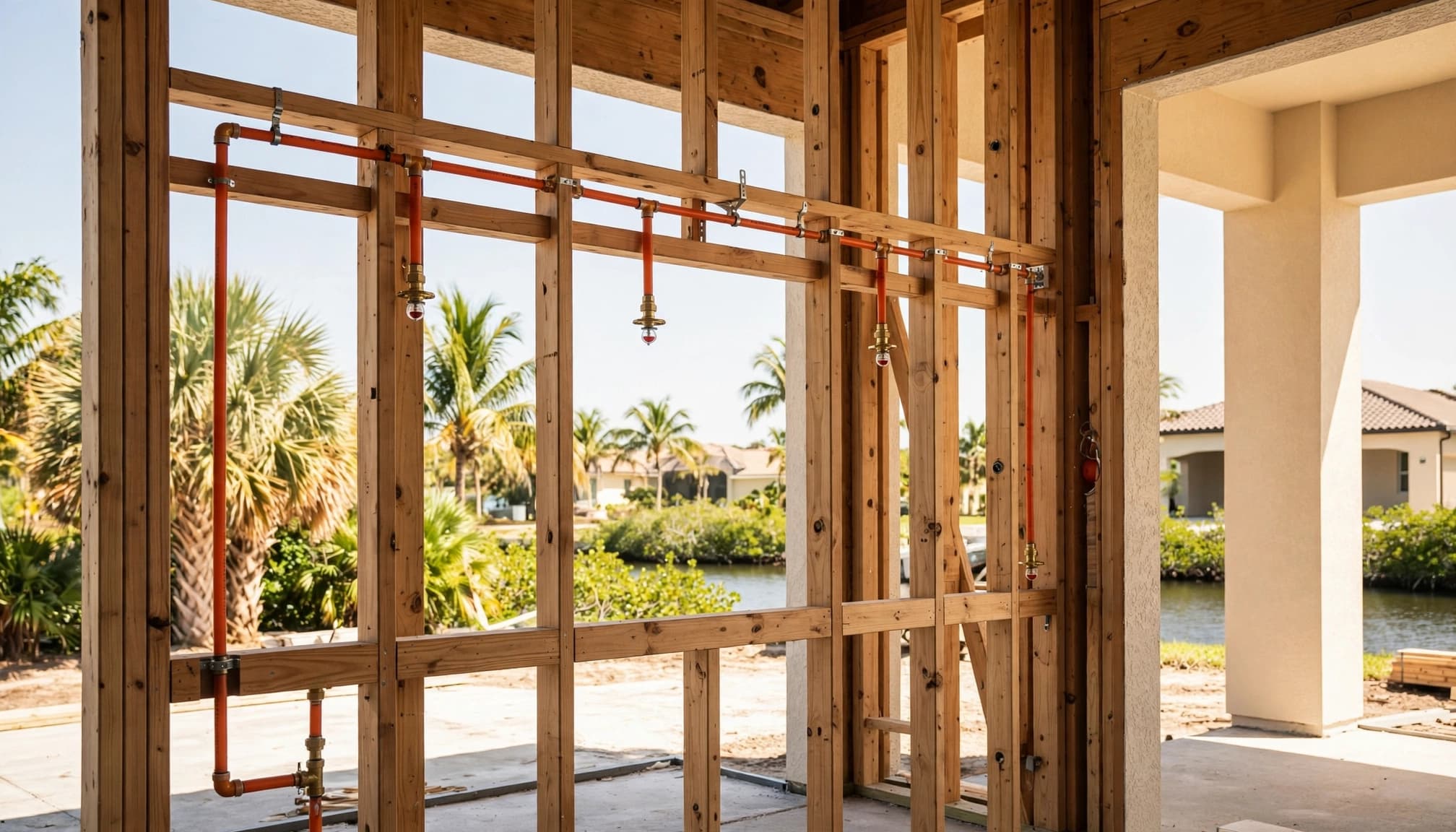
An NFPA 13D system has a designed water supply, piping network, listed sprinkler heads, and layout based on the home's rooms and ceiling conditions. The plans may need to address water flow and pressure, pipe sizing, and the connection to the domestic water service.
Open-concept ceilings, tray ceilings, soffits, garages, attached casitas, and large lanais can affect the design. A sprinkler contractor should coordinate with the architect and plumbing team early, rather than force changes after framing.
Ask about maintenance before you commit
A sprinkler system isn't a set-it-and-forget-it feature. Owners need access to valves and must avoid hanging objects from sprinkler heads or painting them. Freezing is not the primary local concern in Cape Coral, but corrosion, accidental damage, renovations, and water-supply changes still deserve attention.
Ask for the system's operating instructions, product information, final plans, and any required inspection records at project closeout. Keep them with your home documents.
Put fire protection in the permit plan
Sprinklers should appear in the earliest design conversations when they are required or selected. Late additions can disrupt framing, lighting, HVAC placement, plumbing routes, and finished ceiling details.
A coordinated plan also helps avoid vague allowances in a construction proposal. The work should identify who designs the system, pulls the permit, performs inspections, and pays for related water-service upgrades if they are needed.
For a broader look at plan sets, surveys, product approvals, and trade coordination, review this Cape Coral new home permit checklist.
Who can pull the sprinkler permit
Florida regulates automatic fire sprinkler contracting. Under Florida Statutes Section 633.224, fire sprinkler work for one-family and two-family homes requires the appropriate state certification, such as a Contractor I, Contractor II, or Contractor IV license.
A general contractor coordinates the overall build, but the sprinkler trade work should be handled by a properly licensed fire sprinkler contractor when a system is part of the project. Confirm the permit arrangement with Cape Coral before work starts.
Keep related plans consistent
The sprinkler drawings should agree with the architectural and plumbing plans. Ceiling height changes, revised room names, added storage, or a shifted mechanical room can trigger revisions.
This coordination matters in Southwest Florida because custom homes also face wind, flood, roof, and product-approval requirements. Hurricane-zone building code requirements should be reviewed alongside the fire-protection scope, not after plans are complete.

Inspections and construction coordination
When a residential sprinkler system is required or voluntarily included, expect permit review and inspections before the system is concealed and again as required by the City. The exact sequence depends on the approved drawings and Cape Coral's current procedures.
The contractor may need to show piping, fittings, sprinkler-head locations, valves, and the water-supply connection. Don't schedule insulation or drywall until required rough inspections have passed.
Avoid field changes without review
A framing crew may suggest moving a soffit. An electrician may relocate a recessed light. Either change can affect sprinkler spacing or discharge patterns.
Bring the sprinkler contractor into those decisions. If a change requires revised drawings or City approval, handle it before work gets covered. Small layout changes are far less expensive during rough construction than after finishes are installed.
A concise Cape Coral compliance checklist
Use this list before finalizing your custom home design:
- Confirm the home's intended use is a standard one-family dwelling, not a care, group-living, or mixed-use occupancy.
- Ask the City of Cape Coral whether the project will be reviewed under the Residential or Building code.
- Verify the Florida Building Code edition that applies to the permit date.
- Request written clarification if a reviewer, lender, insurer, HOA, or developer raises a sprinkler requirement.
- If sprinklers are included, have a properly licensed fire sprinkler contractor design the system to the applicable standard.
- Coordinate sprinkler drawings with architectural, plumbing, electrical, HVAC, and ceiling plans.
- Identify permits, inspections, water-service work, and responsibility for closeout documents in the construction contract.
Build the answer into the plans
For most standard detached homes, Florida's Residential code does not automatically require fire sprinklers. Yet the correct answer for a Cape Coral custom build depends on the approved code path, property use, local review, and final drawings.
Confirming those details early protects the budget and keeps the construction schedule moving. A clear written determination is more useful than relying on a neighbor's experience or a builder's general rule of thumb.