Slab Moisture Flooring Choices for Estero New Homes
Explore Our Services
Contact Us Today!
(239) 322-9295
Your flooring can look perfect at the design center and still be the wrong choice for a damp concrete slab. For Estero buyers, slab moisture flooring decisions should begin with the concrete's condition, not only a sample's color, texture, or price.
Warm, humid weather, recent slab pours, and an enclosed home can leave moisture below the surface. The practical path is clear: test the slab, match the material and adhesive to the results, and confirm every installation requirement in writing. Start with the concrete before choosing the finish.
Why slab moisture flooring starts with the concrete slab
Concrete is hard, but it still holds and releases moisture. In a slab-on-grade home, the concrete sits close to soil, so water vapor can move through it unless the foundation assembly controls that movement.
Flooring installed before the slab meets its moisture limits may develop adhesive problems, loose planks, cupping, staining, or other failures. The result depends on the product, adhesive, slab condition, and installation method.
In Estero, construction may continue while the home remains open to rain and humid air. A slab can look dry while moisture remains deeper inside. Testing belongs in the flooring schedule, rather than at the last minute before closing.
Moisture can move up through concrete
A vapor retarder is a layer installed below a slab to slow water vapor from the soil. ASTM F710 says slab-on-ground concrete should have a sub-slab moisture vapor retarder that meets ASTM E1745 and sits directly beneath the slab.
That layer helps control vapor, but it doesn't remove the need for testing after the concrete cures. Ask how the vapor retarder, plumbing penetrations, joints, and slab preparation appear in the plans.
A Southwest Florida slab and foundation inspection can help buyers document visible work before concrete covers it. This inspection doesn't replace code inspections or flooring tests.
A dry-looking surface can mislead
Surface appearance is a poor moisture test. A smooth, light-colored slab may still release vapor, especially after rain or while the home's air-conditioning system hasn't run through a normal drying period.
Your flooring choice should follow recorded readings, product instructions, and slab preparation results. A sample board can't provide that information.
How slab moisture flooring testing works
Two common methods appear in flooring specifications: in-situ relative humidity testing and calcium chloride testing. They measure different conditions, so the results shouldn't be treated as interchangeable.
Relative humidity testing looks inside the slab
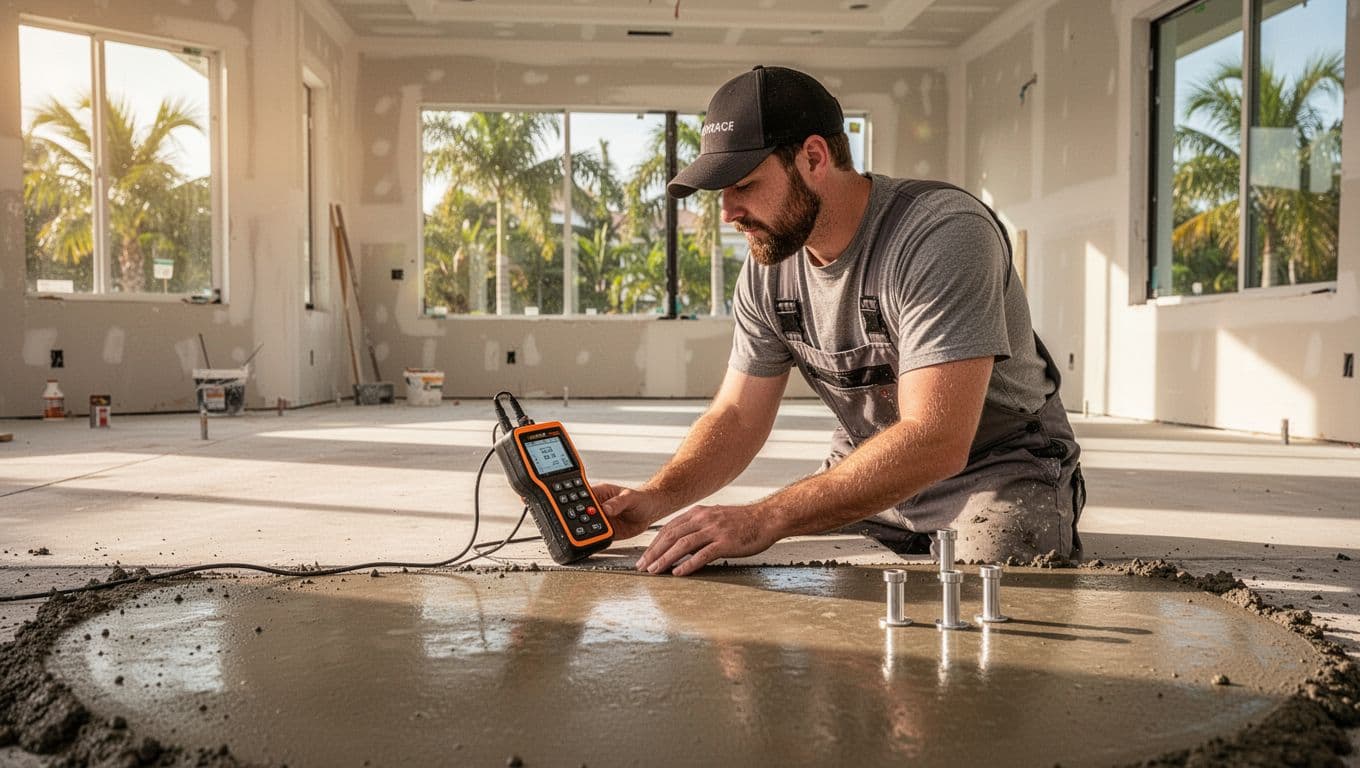
ASTM F2170 is the in-situ relative humidity method for concrete slabs. It uses probes placed inside drilled test holes to measure moisture conditions within the concrete.
Relative humidity, or RH, is a percentage that shows how close the moisture inside the slab is to saturation. A higher reading means more moisture remains available to move toward the flooring system.
For a slab drying from one side, test holes are typically placed at about 40% of the slab's depth. The holes need time to stabilize, often at least 72 hours, before the readings are evaluated.
ASTM F710 lists 75% RH as a common limit for resilient flooring unless the flooring or adhesive manufacturer requires a different value. That number isn't universal. Some products call for a lower reading.
Surface emission and pH answer different questions
ASTM F1869 uses calcium chloride to measure moisture vapor emission from the slab surface. A common ASTM F710 reference limit is no more than 3 pounds per 1,000 square feet during 24 hours, unless the product instructions state otherwise.
This test measures vapor leaving the upper portion of the slab. It doesn't show the same internal moisture condition measured by ASTM F2170. The two readings can't be converted into one another.
A pH test checks the alkalinity at the concrete surface. It matters because some adhesives have specific pH limits, but there isn't one universal pH number for every flooring product. Follow the exact requirements for the selected floor and adhesive.
A passing result under one test method doesn't automatically prove that a different flooring system is ready for installation.
Ask for the testing method, date, location, readings, and product limits in the project records. For larger areas, ask whether the tester followed the standard's sampling guidance, including multiple test locations.
Compare slab moisture flooring materials before you buy
The material affects how much moisture risk the flooring system can tolerate. However, no floor should be selected by material name alone. The exact product, adhesive, underlayment, and installation method all matter.
Porcelain and ceramic tile
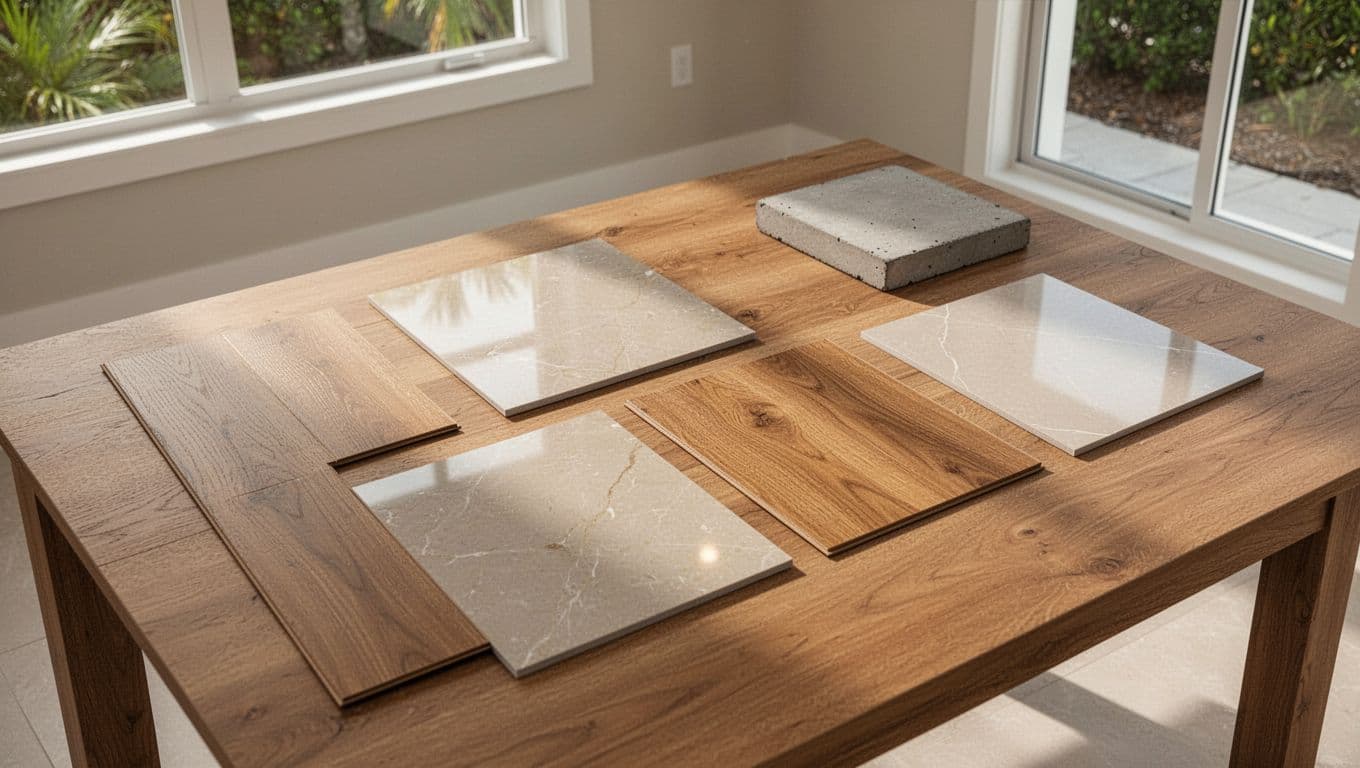
Porcelain and ceramic tile don't swell the way wood-based flooring can. Still, the tile itself is only one part of the assembly.
Thinset, grout, crack-isolation products, leveling materials, and movement joints each have installation requirements. Grout isn't automatically waterproof, and tile doesn't stop vapor from moving through a slab.
Tile can be a practical choice for kitchens, bathrooms, entries, and living areas, but the concrete still needs proper testing and preparation. Ask whether the selected mortar and any membrane are approved for the slab's moisture condition.
Luxury vinyl plank
Luxury vinyl plank is popular in Southwest Florida because many products resist spills and routine household moisture. However, water-resistant and waterproof are not the same claim .
A waterproof label usually applies to the plank and its seams under stated conditions. It doesn't make the concrete slab waterproof. Moisture vapor can still affect adhesive, underlayment, or the bond between the floor and substrate.
Floating and glue-down products also have different requirements. Confirm the permitted RH, emission, pH, subfloor flatness, and underlayment specifications for the exact product line.
Engineered wood and carpet
Engineered wood has layered construction, but it still contains wood. Moisture limits, acclimation, expansion space, adhesive selection, and installation direction can affect the finished floor.
Carpet and pad also need a clean, dry slab. Moisture can affect adhesives and create conditions that damage the pad or flooring materials. Ask whether the product is approved for installation over concrete and whether a separate moisture-control system is required.
Match the material to the full installation system
A floor assembly includes more than the visible surface. It may include the concrete, patching compound, leveling material, primer, adhesive, underlayment, and finish flooring.
Read the flooring and adhesive specifications
Start with the installation guide for the exact product. Then read the adhesive instructions separately if the floor is glued down.
Look for requirements covering:
- Maximum RH or calcium chloride readings
- Surface pH limits
- Slab flatness and surface profile
- Concrete cure requirements
- Approved primers, adhesives, and underlayments
- Acclimation, temperature, and indoor humidity
- Crack treatment and expansion gaps
Manufacturers may set stricter limits than ASTM's common reference values. If the flooring guide and adhesive guide differ, ask the flooring professional which requirement controls before ordering materials.
Plan selections early with the Southwest Florida new construction design selection timeline. Special-order flooring, transitions, leveling products, and moisture systems can affect the schedule.
Confirm slab preparation and climate control
The installer should check whether the slab is clean, sound, flat, and ready for the selected system. Dust, curing compounds, uneven areas, cracks, and contaminated surfaces can affect installation even when moisture readings pass.
The home also needs suitable temperature and humidity conditions during installation and curing. Ask when the HVAC system will operate, whether dehumidification is planned, and how the installer will document conditions.
Questions to ask at the builder walkthrough
Bring these questions to the pre-flooring walkthrough and design meeting:
- Is the home built on a slab-on-grade foundation, and what vapor retarder was installed beneath the slab?
- Where is the vapor retarder shown in the construction plans or inspection records?
- Which moisture test method will be used, ASTM F2170, ASTM F1869, or both?
- How many test locations will be checked, and will the readings be documented in writing?
- What RH, vapor emission, and pH limits apply to the exact flooring and adhesive selected?
- Has the slab had enough time to cure and dry under the home's expected temperature and humidity conditions?
- What slab repairs, leveling, crack treatment, primer, or moisture mitigation are included in the flooring installation?
- If the reading exceeds the product limit, who will recommend the next step and approve the revised installation plan?
Ask for copies of the moisture report and product instructions. A verbal statement that the slab is "dry enough" doesn't give you the same information as documented test results.
What to do if the slab fails a moisture test
A high reading means the flooring installation needs another review. It doesn't automatically prove that the foundation is defective.
Pause flooring and document the results
Keep the test report, photographs, product information, and installation notes together. Confirm whether the issue involves internal RH, surface emissions, pH, a leak, rain exposure, or another condition.
The builder may need to allow more drying time, improve climate control, repair a plumbing issue, or investigate moisture entering through the slab assembly. Retesting should follow the applicable standard and product instructions.
Don't cover the slab while the result remains unresolved. Flooring can hide the surface and make later investigation harder.
Use an approved mitigation plan
Moisture mitigation is product-specific. Depending on the readings and flooring system, the plan may involve an approved moisture-control system, a different adhesive, additional slab preparation, a different floor product, or a delayed installation.
A qualified flooring professional should select and install the system. Generic sealers, extra plastic, or a last-minute product change may conflict with the flooring warranty or adhesive requirements.
Get the proposed solution in writing. The documentation should identify the product, preparation steps, installation limits, responsible contractor, and required retesting.
Conclusion
The best slab moisture flooring decision for an Estero new home starts with measured slab conditions. Confirm the vapor retarder, use the correct moisture tests, and compare the results with the exact flooring and adhesive specifications.
Water resistance can help with spills, but it doesn't replace moisture control beneath the floor. When readings are high, pause the installation and use a documented plan from qualified flooring professionals. A careful flooring decision protects the finish you chose and reduces avoidable surprises after move-in.